Wednesday, November 18, 2009

WP3: Cursory Analysis

My assigned art object is titled "Monet's Table (from the Lilypad Series)." It was created by the artist Michael Todd (left), who sculpts with a variety of materials including wood, steel, bronze, and clay. In this case, Todd uses steel to compose this entire piece of art. As the name suggests, Monet's Table takes the form of an actual table; however, it's shaped a bit differently than most modern tables. The top surface is formed buy two layers of circular panels. The top layer overlaps parts of the bottom layer, and various empty spaces are present between each of the circular panels. The table is held up by three legs, each forming a different shape. The most interesting leg, in my opinion, is made of two arcs, reaching past the top surface of the table, welded to the outer edge. The next leg is a somewhat wide cylinder, only half of which can be seen from above the table. The last leg, perhaps the least interesting, was a simple, flat rectangle; it was, however, positioned in an odd manner so that just a corner was attached to the top of the table.

I think the most important aspect of all these pieces is the contrast between the top of the table and the legs. The top surface of the table creates visual unity through repition of shapes, or, or specifically, circular panels. The legs of the table break this visual unity via contrasting shapes. The color, texture, and material, on the other hand, support this uniformity of the table; the entire steel piece is grey and a bit rusted, giving it a weathered appearance.

Another important aspect of this piece is its position amongst its surroundings. First of all, there are many picnic tables and benches in the area, which can signify that this location is one of social gathering--a place to meet and look at the art perhaps. However, Monet's table is placed lower than the picnic tables, giving it more of a coffee table appearance. It's cold, rough, and jagged, which makes it sort of uninviting, contradicting its purpose as a table.

More importantly, I feel, the table is positioned half way under a bridge. I noticed that, even as I sat and observed this piece of art, the shadow that was cast by the bridge slowly moved across the surface of the table as the sun moved through the sky, emphasizing the changing environment in which the table is placed. I'm not sure if it was positioned under the bridge for this reason, but it might have some importance to the context. The title here is extremely important. Monet was a famous artist who advocated the Impressionist style in his paintings. Also, as the title of this art object suggests, Monet created a series of paintings depicting water-lilies. From this, I can understand that the circular steel panels making the tabletop are supposed to be lily pads. Perhaps the lack of detail in these lily pads is an important aspect of Impressionism?

Sunday, November 15, 2009

WP3: Pre-Writing Assignment 1:

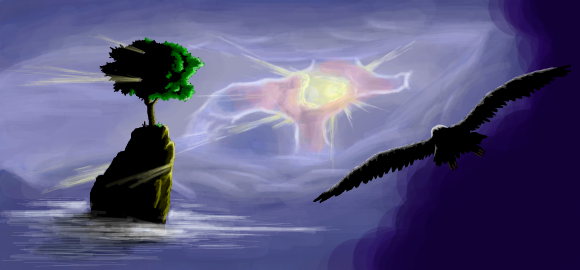
I am a huge fan of art. I've often thought about getting some sort of art major here at UNL, which is quite a big jump from computer engineering, but I suppose I am content with simply creating my art in my own free time. In any case I haven't actually had too much experience with art-objects. I most certainly have had absolutely no experience rhetorically analyzing art-objects outside of this English class, and I suppose nothing that I've created makes any form of argument in a manner similar to that of "Breach," though I have tried to give some of my most recent works art a bit more meaning; apparently this English course has influenced me to some extent.

Most of my experience with art-objects is composed of simple art classes in high school such as Intro to Art and Graphic Design courses. In Intro to Art I mostly dealt with a weekly sketching assignment, in-class water-color paintings, sculptures, and other random activities. In Graphic Design I simply learned how to use photoshop by editing some pictures. In retrospect, neither of these courses did much to contribute to my abilities as an artist. It seems to me that I've learned a lot more by simply drawing in my own free time. That said, most of my "art-objects" are simply pencil sketches, but I also enjoy creating Facebook graffitis using the graffiti application.

None of my artwork is by any means "professional," but I always enjoy creating pictures like this. Art is, for the most part, a way for me to relax and let my imagination run free. I used to simply draw realistic pictures or events, but lately I've been drawing slightly more abstract pictures merely because it allows me to experiment with a greater range of ideas. Whether I be doodling in class or dedicating a time-consuming graffiti to a friend, art will always simply be a way for me to free my mind and escape from reality.

Friday, November 13, 2009

WP2: Final Draft

Author's Note:

From Rough Draft 1 to Rough Draft 2, I made only a couple of modifications due to constraints on time; however, the changes that I made are rather important to the content of my final draft. After rereading my essay a couple more times, I conclude that the paragraph beginning "The facial expressions of the two characters..." clearly did not fit into my essay since most of my essay's content revolved around the unique use of panels. After removing this paragraph I decided to "beef up" the paragraph before it that talked about the use of hues in certain groups of panels. This paragraph felt extremely underdeveloped to me because I never actually connected it to the context or the argument when I first wrote it. Thus, I nearly doubled it's length by adding these connections, using language from our textbook and giving it far more importance than it had originally. For example, I talk about "visual unity using repetition of hues in each panel," and I state that it contributes to logos.

The second to last paragraph about the symbolic use of the pterodactyl also seemed to fit rather awkwardly into my essay, but I felt like it covered an important concept that needed to be discussed. Thus, from my second draft to my final draft, I completely removed the paragraph, but inserted the important concepts into parts of the essay that helped to support it. For example, I altered the sentence beginning with "Through this dream Calvin is fulfilling his wish to fly..." by dividing it into two sentences and adding "Calvin is fulfilling his wish to be free from reality just as the pterodactyl is free from the confines of gravity." I didn't directly mention symbolism because that is an entirely different rhetorical element that would subtract from the purpose of the paragraph; I simply wanted the audience to see how the pterodactyl is being used in Calvin's dream.

I also worked a bit on transitions from paragraph to paragraph. At the end of the paragraph beginning with "The concepts of..." I added a final sentence "This relationship is clearly shown through the alignment of panels." This sentence connects the relationship between dreams and denial to the alignment of the panels, helping to transition from one paragraph to the next. At this point, I felt as if the body of the essay had improved enough, so I turned my attention to the conclusion after running through one last time to tweak word choices and correct a few grammar mistakes. My conclusion felt like it simply brought the essay to a halt rather than actually conclude with a meaningful sentence. Thus, I tried to finish with something a little more powerful: "No matter how hard Calvin the pterodactyl flaps his wings, will he ever truly be free from the gravity of his unpleasant situation?" I could have simply inserted this as a statement, but I feel that leaving it in the form of a question allows the conclusion to relate more closely to the audience, which is the overall goal of my conclusion.

Rough Draft 2
Rough Draft 1
Statement of Purpose


Final Draft:

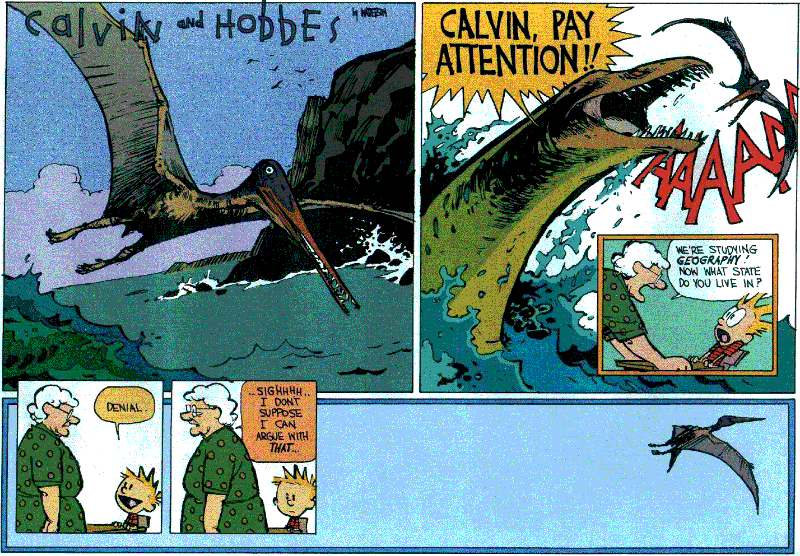
Denial is a common defense mechanism that is often viewed as a potentially harmful method of coping with anxiety. Through this comic strip, Bill Watterson uses humor to show some of the more serious effects of denial, revealing a thin line between the active use of the imagination and this harmful defense mechanism. Watterson uses a unique arrangement of the panels in this comic strip to guide the audience through an otherwise unclear path. This arrangement leads the audience to make comparisons between different frames of the comic and, in a similar fashion, the different uses of denial. Within this arrangement Watterson uses aspects such as the level of detail, size of the panels, and different hues to show extensively the contrast between dream and reality.

The concepts of denial, dreams, and the imagination are all important aspects of psychoanalysis, a comprehensive theory of human nature and behaviour. Sigmund Freud, a famous neurologist who developed much of what we know to be the theory of psychoanalysis, theorized that dreams are basically a "fulfillment of wishes" (Chiriac 5). This can be clearly seen in the comic strip, where Calvin daydreams that he is a pterodactyl. Through this dream, Calvin is fulfilling his wish to fly and to be a dinosaur. More importantly, however, Calvin is fulfilling his wish to be free from reality just as the pterodactyl is free from the confines of gravity. Coincidentally, denial, another concept originating from the theories of Freud, "entails ignoring or refusing to believe an unpleasant reality" (Encyclopedia of Mental Disorders 3). Calvin, as he says himself, is in a state of denial. Calvin chooses to ignore the "unpleasant reality" of his geography class through the act of daydreaming--or imagining himself flying around as a pterodactyl in prehistoric times. Thus, Calvin's dream, a product of his vivid imagination, is directly related to the denial of his unpleasant reality. This relationship is clearly shown through the alignment of panels.

Bill Watterson is well known for using unique arrangements of panels in his comic strips. For example, in this strip, none of his panels are aligned and some of them are even tilted. Similarly, panels in the primary comic overlap one another and are greatly varied in proportions. Watterson uses this unique setup to both help support the purpose of his comic and to ensure that the audience is guided along the intended path of his comic strip, moving from one panel to the next. As a result of this setup in the primary comic, a sort of background and foreground is produced. The background is filled with all of the panels that resemble Calvin's daydream while the foreground is composed of a few panels depicting his reality. This structure creates a logos that demonstrates the focus on reality over imagination; generally speaking, the foreground is the main focus rather than the background, and this comic is reflective of that. However, the differences between these two elements contradict the logic of this structure, demonstrating the effects of denial.

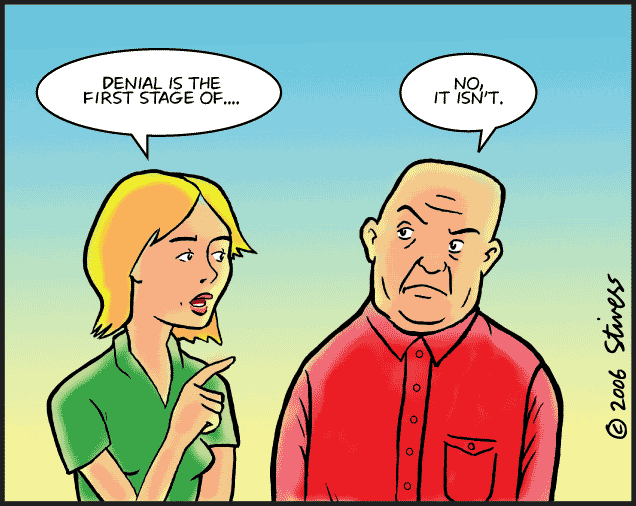
Watterson strengthens his argument by creating several differences between the background and foreground besides the fact that one represents fantasy while the other shows reality. The panels displaying Calvin's imagination are enlarged to the point that they cover the entire strip, while the panels depicting reality are notably smaller, and overlapping the background panels. Additionally, the panels in the background show much more detail than those of the foreground through aspects such as shading and the overall number of hues. The difference in size and detail of these panels not only emphasize the extent of Calvin's imagination, but also reflect Calvin's rejection, or denial, of the reality in which he is trapped. Truly, throughout this entire strip, Calvin's imagination seems to carry much more importance than his reality. The above comic strip uses a similar method, enlarging the pieces of Calvin's imagination and giving them more detail. In both cases we could conclude that Calvin either has a vivid imagination or that he lives in denial, in his own little world.

The author's choice of hues plays a crucial role in emphasizing the contrast between fantasy and reality. In the majority of the panels depicting dinosaurs, the background is filled with shades of blue. On the other hand, the background is completely white in the two reality-based panels located at the bottom left of the strip. This creates visual unity using repetition of hues in each panel, causing the remaining two panels to contrast with the rest of the comic; the hues are completely swapped in these two panels where Calvin is called out of the daydream by his teacher, showing a transition from dream to reality. This logos causes the audience to make a comparison between these two panels. Additionally, the two panels in the upper right are split in nearly the same way by a white sky in one and a white speech bubble in the other, linking the two panels together and further helping to lead the audience into making a comparison. Because one panel is positioned in front of the other, the two panels share an extremely close relationship. From this, the audience can clearly see that Calvin is the pterodactyl and his teacher is the dinosaur that's coming out of the water. All of these aspects support the juxtaposition being used by the author, showing the similarities between two completely opposite concepts: Imagination and reality.

Calvin is well known for having an active imagination; after all, the "Calvin and Hobbes" comic strip series is almost always centered around the adventures of both Calvin and his imaginary talking tiger friend, Hobbes; it could be assumed that Calvin lives in denial of the fact that he has no real friends. Defense mechansims such as denial are often regarded as "potentially maladaptive behavioral patterns that may lead to psychological disorders" (Encyclopedia of Mental Disorders 3). Does this mean that Calvin lives in denial with the threat of developing a psychological disorder, or is Calvin simply a child who likes to fantasize about dinosaurs and flying through the clouds? Should these two ideas be regarded as one and the same? These are the questions that Watterson's comic forces us to ask ourselves. Most people who see this comic strip have probably experienced a situation similar to that of Calvin--sitting in a boring class at school and letting the mind wander far away. As a result we can easily connect to the strip and apply it to ourselves. Most of us have probably never considered ourselves to be in a state of denial for simply daydreaming or imagining ourselves elsewhere. Nonetheless, the effects of both denial and daydreaming can be viewed in the same manner. No matter how hard Calvin the pterodactyl flaps his wings, will he ever truly be free from the gravity of his unpleasant situation?


Works Cited

Chiriac, Jean. "Dream Interpretation and Psychoanalysis." 2009. AROPA <http://freudfile.org/psychoanalysis/dream_interpretation_and.html>.

Encyclopedia of Mental Disorders. "Denial." 2009. Advameg, Inc. <http://www.minddisorders.com/Del-Fi/Denial.html>

Wednesday, November 11, 2009

WP2: Rough Draft 2

Denial is a common defense mechanism that is often viewed as a potentially harmful method of coping with anxiety. Through this comic strip, Bill Watterson uses humor to show some of the more serious effects of denial, revealing a thin line between the active use of the imagination and this harmful defense mechanism. Watterson uses a unique arrangement of the panels in this comic strip to guide the audience through an otherwise unclear path. This arrangement leads the audience to make comparisons between different frames of the comic and, in a similar fashion, the different uses of denial. Within this arrangement Watterson uses aspects such as the level of detail, size of the panels, and typography to show extensively the contrast between dream and reality.

The concepts of denial, dreams, and the imagination are all important aspects of psychoanalysis, a comprehensive theory of human nature and behaviour. Sigmund Freud, a famous neurologist who developed much of what we know to be the theory of psychoanalysis, theorized that dreams are basically a "fulfillment of wishes" (Chiriac 5). This can be clearly seen in the comic strip, as Calvin daydreams that he is a pterodactyl. Through this dream Calvin is fulfilling his wish to fly, to be a dinosaur, or, more importantly, to escape reality. Coincidentally, denial, another concept originating from the theories of Freud, "entails ignoring or refusing to believe an unpleasant reality" (Encyclopedia of Mental Disorders 3). Calvin, as he says himself, is in a state of denial. Calvin chooses to ignore the "unpleasant reality" of his geography class through the act of daydreaming--or imagining himself flying around as a pterodactyl in prehistoric times. Thus, Calvin's dream, a product of his vivid imagination, is directly related to the denial of his unpleasant reality.

Bill Watterson is well known for using unique arrangements of panels in his comic strips. For example, in this strip, none of his panels are aligned and some of them are even tilted. Similarly, panels in the primary comic overlap one another and are greatly varied in proportions. Watterson uses this unique setup to ensure that the audience follows a strict path through the comic strips, moving from one panel to the next and to help support the purpose of the comic. As an effect to this setup in the primary comic, a sort of background and foreground is produced. The background is filled with all of the panels that resemble Calvin's daydream while the foreground is composed of a few panels depicting his reality. This creates a structure that feels logical. Generally speaking, the foreground is the main focus rather than the background, and this comic is reflective of that. However, the differences between these two elements contradict the logic of this structure, demonstrating the effects of denial.

Watterson strengthens his argument by creating several differences between the background and foreground besides the fact that one represents fantasy while the other shows reality.
The panels displaying Calvin's imagination are enlarged to the point that they cover the entire strip, while the panels depicting reality are notably smaller, and overlapping the background panels. Additionally, the panels in the background show much more detail than those of the foreground through aspects such as shading and the overall number of hues. The difference in size and detail of these panels not only emphasize the extent of Calvin's imagination, but also reflect Calvin's rejection, or denial, of the reality in which he is trapped. Truly, throughout this entire strip, Calvin's imagination seems to carry much more importance than his reality. The above comic strip uses a similar method, enlarging the pieces of Calvin's imagination and giving them more detail. In both cases we could see that Calvin has a vivid imagination or that he lives in denial, in his own little world.

The author's choice of hues plays a crucial role in emphasizing the contrast between fantasy and reality. In the majority of the panels depicting dinosaurs, the background is filled with shades of blue. On the other hand, the background is completely white in the two reality-based panels located at the bottom left of the strip. This creates visual unity using repetition of hues in each panel, causing the remaining two panels to contrast with the rest of the comic; the hues are completely swapped in these two panels where Calvin is called out of the daydream by his teacher, showing a transition from dream to reality. This logos causes the audience to make a comparison between these two panels. Additionally, the two panels in the upper right are split in nearly the same way by a white sky in one and a white speech bubble in the other, linking the two panels together and further helping to lead the audience into making a comparison. Because one panel is positioned in front of the other, the two panels share an extremely close relationship. From this, the audience can clearly see that Calvin is the pterodactyl and his teacher is the dinosaur that's coming out of the water. All of these aspects support the juxtaposition being used by the author, showing the similarities between two completely opposite concepts: Imagination and reality.

Watterson uses the prehistoric bird and the concept of flight itself as a symbol of freedom. Calvin, out of complete boredom, denies his own existence in the classroom, thus freeing his mind just as the pterodactyl in the comic strip is free from the limits of gravity. Psychoanalytically, this means that Calvin is in denial because he ignores the reality of his geography class by daydreaming in order to fulfill his wish of being free. At a glance, this might seem completely fine, but has Calvin solved his problem, truly freeing himself from his unpleasant reality? In the very last frame, the pterodactyl can be seen drifting along, continuing its flight; Calvin has once again returned to his dream, perhaps even as he speaks to his teacher. The two frames depicting reality overlap this final frame, suggesting that Calvin's imagination continues while he converses with his teacher.

Calvin is well known for having an active imagination; after all, the "Calvin and Hobbes" comic strip series is almost always centered around the adventures of both Calvin and his imaginary talking tiger friend, Hobbes; it could be assumed that Calvin lives in denial of the fact that he has no real friends. Defense mechansims such as denial are often regarded as "potentially maladaptive behavioral patterns that may lead to psychological disorders" (Encyclopedia of Mental Disorders 3). Does this mean that Calvin lives in denial with the threat of developing a psychological disorder, or is Calvin simply a child who likes to fantasize about dinosaurs and flying through the clouds? Should these two ideas be regarded as one and the same? These are the questions that Watterson's comic forces us to ask ourselves. Most people who see this comic strip have probably experienced a situation similar to that of Calvin--sitting in a boring class at school and letting the mind wander far away. As a result we can easily connect to the strip and apply it to ourselves. Most of us have probably never considered ourselves to be in a state of denial for simply daydreaming or imagining ourselves elsewhere.


Works Cited

Chiriac, Jean. "Dream Interpretation and Psychoanalysis." 2009. AROPA <http://freudfile.org/psychoanalysis/dream_interpretation_and.html>.

Encyclopedia of Mental Disorders. "Denial." 2009. Advameg, Inc. <http://www.minddisorders.com/Del-Fi/Denial.html>

Sunday, November 8, 2009

WP2: Rough Draft 1

Denial is a common defense mechanism that is often viewed as a potentially harmful method of coping with anxiety. Through this comic strip, Bill Watterson uses humor to show some of the more serious effects of denial, revealing a thin line between the active use of the imagination and this harmful defense mechanism. Watterson uses a unique arrangement of the panels in this comic strip to guide the audience through an otherwise unclear path. This arrangement leads the audience to make comparisons between different frames of the comic and, in a similar fashion, the different uses of denial. Within this arrangement Watterson uses aspects such as the level of detail, size of the panels, and typography to show extensively the contrast between dream and reality.

The concepts of denial, dreams, and the imagination are all important aspects of psychoanalysis, a comprehensive theory of human nature and behaviour. Sigmund Freud, a famous neurologist who developed much of what we know to be the theory of psychoanalysis, theorized that dreams are basically a "fulfillment of wishes" (Chiriac 5). This can be clearly seen in the comic strip, as Calvin daydreams that he is a pterodactyl. Through this dream Calvin is fulfilling his wish to fly, to be a dinosaur, or, more importantly, to escape reality. Coincidentally, denial, another concept originating from the theories of Freud, "entails ignoring or refusing to believe an unpleasant reality" (Encyclopedia of Mental Disorders 3). Calvin, as he says himself, is in a state of denial. Calvin chooses to ignore the "unpleasant reality" of his geography class through the act of daydreaming--or imagining himself flying around as a pterodactyl in prehistoric times. Thus, Calvin's dream, a product of his vivid imagination, is directly related to the denial of his unpleasant reality.

Bill Watterson is well known for using unique arrangements of panels in his comic strips. For example, in this strip, none of his panels are aligned and some of them are even tilted. Similarly, panels in the primary comic overlap one another and are greatly varied in proportions. Watterson uses this unique setup to ensure that the audience follows a strict path through the comic strips, moving from one panel to the next and to help support the purpose of the comic. As an effect to this setup in the primary comic, a sort of background and foreground is produced. The background is filled with all of the panels that resemble Calvin's daydream while the foreground is composed of a few panels depicting his reality. This creates a structure that feels logical. Generally speaking, the foreground is the main focus rather than the background, and this comic is reflective of that. However, the differences between these two elements contradict the logic of this structure, demonstrating the effects of denial.

Watterson strengthens his argument by creating several differences between the background and foreground besides the fact that one represents fantasy while the other shows reality.
The panels displaying Calvin's imagination are enlarged to the point that they cover the entire strip, while the panels depicting reality are notably smaller, and overlapping the background panels. Additionally, the panels in the background show much more detail than those of the foreground through aspects such as shading and the overall number of hues. The difference in size and detail of these panels not only emphasize the extent of Calvin's imagination, but also reflect Calvin's rejection, or denial, of the reality in which he is trapped. Truly, throughout this entire strip, Calvin's imagination seems to carry much more importance than his reality. The above comic strip uses a similar method, enlarging the pieces of Calvin's imagination and giving them more detail. In both cases we could see that Calvin has a vivid imagination or that he lives in denial, in his own little world.

The author's choice of hues also plays an important role. In the first and last frame, where Calvin is drawn as a dinosaur, the background is filled with blue. On the other hand, the background is white in the two panels located at the bottom left of the strip. These hues are completely swapped in the other two panels where Calvin is called out of the daydream by his teacher. This helps to show that the comic is being transitioned from imagination to reality and then back again. Additionally, the two panels in the upper right are split in nearly the same way by a white sky in one and the white speech bubble in the other. This links these two panels together, forcing the audience to make a comparison. Because one panel is positioned in front of the other, the audience can clearly see that Calvin is the pterodactyl and his teacher is the dinosaur that's coming out of the water.

The facial expressions of the two characters helps the audience to more easily interpret the text. As the teacher tells Calvin to pay attention, Calvin's eyes are wide, his mouth is open as if screaming, and his hair is standing straight up. The audience can easily read his expression as one of surprise, which parallels the response of the pterodactyl being attacked by the other dinosaur. Additionally, when Calvin responds to the teacher with the simple answer "denial," he has a large smile on his face, making him look cheerful and carefree. However, when the teacher agrees with him in the next frame, his expression seems to change to that of confusion as if wondering "What did she mean by that?"

Watterson uses the prehistoric bird and the concept of flight itself as a symbol of freedom. Calvin, out of complete boredom, denies his own existence in the classroom, thus freeing his mind just as the pterodactyl in the comic strip is free from the limits of gravity. Psychoanalytically, this means that Calvin is in denial because he ignores the reality of his geography class by daydreaming in order to fulfill his wish of being free. At a glance, this might seem completely fine, but has Calvin solved his problem, truly freeing himself from his unpleasant reality? In the very last frame, the pterodactyl can be seen drifting along, continuing its flight; Calvin has once again returned to his dream, perhaps even as he speaks to his teacher. The two frames depicting reality overlap this final frame, suggesting that Calvin's imagination continues while he converses with his teacher.

Calvin is well known for having an active imagination; after all, the "Calvin and Hobbes" comic strip series is almost always centered around the adventures of both Calvin and his imaginary talking tiger friend, Hobbes; it could be assumed that Calvin lives in denial of the fact that he has no real friends. Defense mechansims such as denial are often regarded as "potentially maladaptive behavioral patterns that may lead to psychological disorders" (Encyclopedia of Mental Disorders 3). Does this mean that Calvin lives in denial with the threat of developing a psychological disorder, or is Calvin simply a child who likes to fantasize about dinosaurs and flying through the clouds? Should these two ideas be regarded as one and the same? These are the questions that Watterson's comic forces us to ask ourselves. Most people who see this comic strip have probably experienced a situation similar to that of Calvin--sitting in a boring class at school and letting the mind wander far away. As a result we can easily connect to the strip and apply it to ourselves. Most of us have probably never considered ourselves to be in a state of denial for simply daydreaming or imagining ourselves elsewhere.


Works Cited

Chiriac, Jean. "Dream Interpretation and Psychoanalysis." 2009. AROPA <http://freudfile.org/psychoanalysis/dream_interpretation_and.html>.

Encyclopedia of Mental Disorders. "Denial." 2009. Advameg, Inc. <http://www.minddisorders.com/Del-Fi/Denial.html>