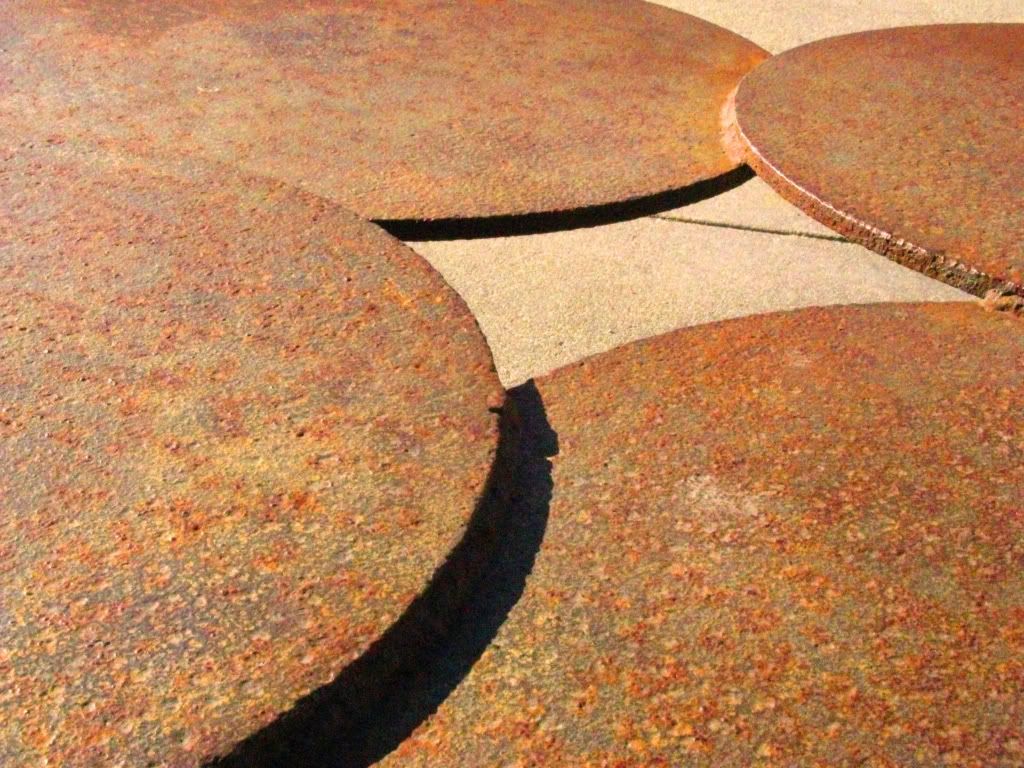
Impressionism was a major movement in paintings, sculpture, and even music, and was founded by the famous painter, Claude Oscar Monet, for whom the above art object is titled. Perhaps most prominent in paintings, the impressionist style is best known today for its attempt at recreating "visual reality in terms of transient effects of light and colour" (Pioch 1). In his art object, "Monet's Table (from the Lilypad Series)," Michael Todd uses various techniques to imitate this impressionist art style, which is supported by certain characteristics only present in three dimensional works of art such as sculpture. Specifically, the art object's position in its environment is used in a near limitless number of ways to achieve this effect, reflecting its forever-changing surroundings upon its audience. Additionally, the material used in the crafting of this art object helps to support the overall impressionist imagery of this piece. Last, but certainly not least, "Monet's Table (from the Lilypad Series)" itself is altered in both minute and extreme cases by another significant dimension: Time. The intricate combination of these characteristics--all unique properties of dynamic, three-dimensional art--work together to contribute to Michael Todd's employment of the impressionist art style, which is most popularly known for its application in paintings.
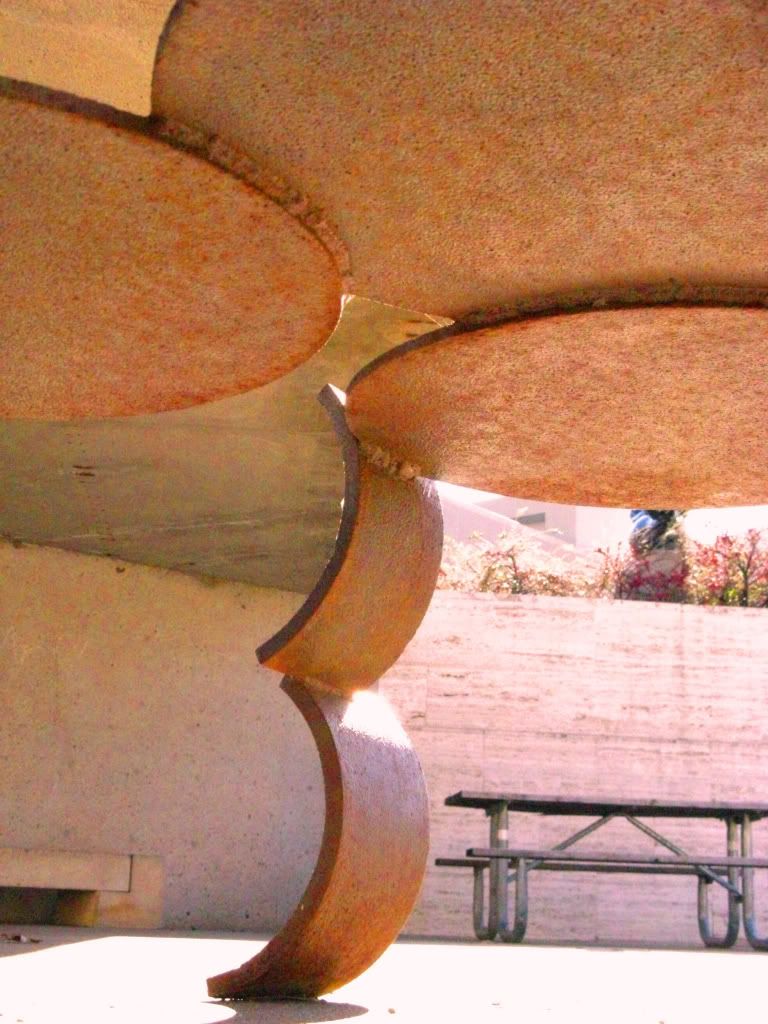 "Monet's Table (from the Lilypad Series)" is strategically placed in a somewhat social area on campus, outnumbered by surrounding picnic tables and benches. These picnic tables and benches create visual unity through repetition. The title of this art object bluntly suggests that it is a table. However, its appearance differs greatly to that of the picnic tables; its top surface is made of circular panels, its legs are oddly shaped, and it is much too low to the ground. In fact, its height is similar to that of the benches in the area, making it sort of an awkward place to carry out table-bound activities. All of these characteristics contradict the utility of this art object as a table, stressing the fact that this "table" was designed for more than just a surface for eating.
  Also, the art object is planted on a rather dull, concrete ground. The hue of the concrete contrasts with that of the art object, causing the audience to see, from many angles, merely the image of various darker circles overlaying the lighter ground. From the part of the title "(from the Lilypad Series)" the audience can gather that this image is actually more of an impression of lily pads gently floating on a still pond. Monet, a vital part of this art object's title, created a large series of paintings based around a water lily pond that he owned. Michael Todd seems to suggest that, of the tables that Monet might have owned, "Monet's Table (from the Lilypad Series)" should have been a member of his collection; after all, the impressionist art style and lily pads both seem to be Monet's two favorite things.
In addition to the aforementioned environmental characteristics, a bridge runs overhead, casting a definitive shadow across the surface of the table whenever the weather creates the right conditions. Coincidentally, the effects of lighting and shadows play a large role in the impressionist art style. The bridge's shadow, however, doesn't completely cover the table, allowing the table itself to produce some shadow on the ground. Clearly, Michael Todd is using logos to create as many interesting shadows as possible, supporting a definitive point of both Monet and the impressionist art style.
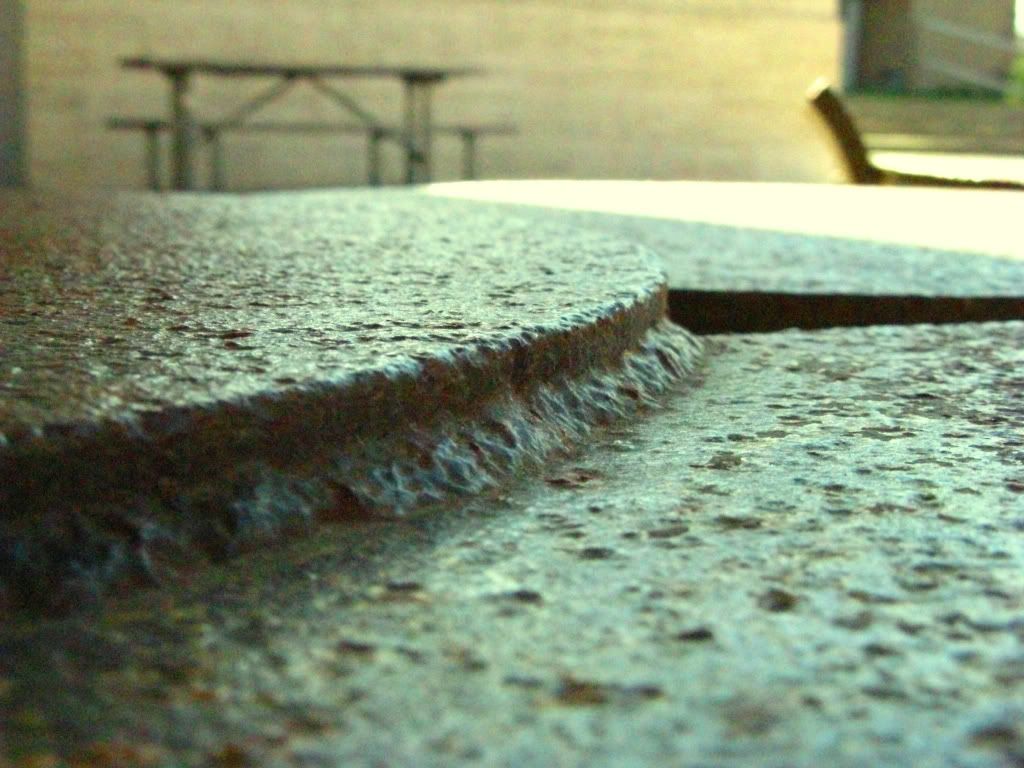 The material and the manner in which it was assembled is also representative of Monet and the impressionist art style that Michael Todd is employing. Impressionist painters often depicted that which they were painting through the use of small, clearly visible brush strokes, sometimes even making small dots with the tip of the paint brush. As a result, a vast majority of impressionist paintings appear to be somewhat unfinished. In a similar manner, the entirety of "Monet's Table (from the Lilypad Series)" is composed of a rough, bumpy surface, as if it were painted on using small, visible brush strokes. The areas that were welded together when forming this art object also remain somewhat rough, causing the piece as a whole to look rather unfinished. This is also supported by the minimal level of detail shown in the table. In general, lily pads are more distinguished than a simple, flat circle. However, to impressionists, the importance of shape and fine details doesn't even come close to rivaling the significance of colors and lighting effects. Michael Todd's goal here was not to create a steel replica of lily pads, but rather to create an impression of lily pads.
 Monet and many other impressionist painters would often return to a location more than once just to paint the same scene from a different viewpoint, during a different season, or simply at a different time of day. Monet most noticeably did this as he painted several pictures of his water lily garden over a course of thirty years. Monet once said "I know that to paint the sea really well, you need to look at it every hour of every day in the same place so that you can understand its way in that particular spot and that is why I am working on the same motifs over and over again, four or six times even." Just as Monet depicted these varying effects of lighting through a multitude of paintings, so to does Michael Todd's placement of "Monet's Table (from the Lilypad Series)." The outdoors environment reflects these changes upon Todd's art object quite noticeably. As the day progresses, the shadow from the overhead bridge slowly moves across the top surface of the art object. Furthermore, as the year progresses, all sorts of different lighting occasions make themselves present through both seasonal and weather changes. Still further, over a much longer period of time, the art object as a whole changes color with the production of rust due to its material composition.
Michael Todd has created a work of art that not only employs the impressionist art style, but uses it in ways that highlight the particular usefulness of the three-dimensional art object genre. Monet created several depictions of specific locations with varying lighting effects which, as a result, generates a unique pathos in each painting. On the other hand, Michael Todd chose to create a singular art object and place it in a location that, due to its unique lighting situations, Monet and other impressionists might find appealing. Todd effectively uses the audience, their viewpoint, and the environment as a part "Monet's Table (from the Lilypad Series)" itself, which generates a different pathos depending on at what time and from what location the audience views it.
Works Cited
Pioch, Nicolas. "Impressionism" June 19, 2006. WebMuseum, Paris <http://www.ibiblio.org/wm/paint/glo/impressionism/>.
artquotes.net. "Claude Monet Quotes" 2009. ArtQuotes.net <http://www.artquotes.net/masters/monet-claude-quotes.htm>