Sunday, December 13, 2009

WP3: Final Draft

Author's Note:

The most notable change that I made lies in the order of the paragraphs. I almost decided to move to the end of the essay's body the paragraph that describes the material composition of the art object. I went in the opposite direction, however, by moving it to the front, realizing that it was the only paragraph in the body of the essay that focuses most Monet's Table itself rather than the environment's impact on Monet's Table through aspects such as lighting and passing of time. With the movement of this single paragraph, the paragraphs that talk about lighting and how it changes with the passing of time are brought together. I feel this is an important alteration to the essay as a whole because these paragraphs are closely related. To help support the flow of the essay, I also altered the paragraph that begins with "In addition to the aforementioned environmental characteristics..." by adding to the end "Of course, these shadows appear to change completely depending on when Monet's Table is viewed and from where the audience views it." This creates a smooth transition to the next paragraph that tackles the matter of changes in shadows and lighting effects over the passing of time.

As a result of shifting the position of the paragraphs in the body of my essay, I also found it necessary to change the order in which I outline my subtopics in the introduction. Thus, just as I reordered the paragraphs in the body, so too did I move the sentence "the material used in the crafting of this art object helps to support the overall impressionist imagery of this piece" to the front of the outline of the subtopics. Additionally, in the same paragraph where I added the transition sentence to the end, I also added the sentence "Colors and lighting effects are among the most important aspects of Monet's paintings." I felt that this paragraph was rather underdeveloped and didn't do very much to support the arguments that were being made, but this sentence helps to better relate the paragraph and its topic back to the context in which I've situated the art object.

Aside from these changes, I made various minute changes all over the essay. Most of these alterations consist of simple changes in word choice that I felt either had a noticeable impact on my intended pathos or altered the overall meaning of individual sentences. For example, I changed the word "However" to "To further support this" in the sentence that now reads "To further support this, the bridge's shadow doesn't completely cover the table, allowing the table itself to produce a shadow on the ground." I feel that this simple change alters the manner in which this sentence supports my sub-argument. Also included in these small changes are various corrections in grammar, spelling, and punctuation. One last change I tried to make pertains to the functionality of one of my hyperlinks. The link labeled "brush strokes" evidently wasn't working for anyone who hasn't visited the linked website, so I relinked it with a change that hopefully fixes this problem for anyone who tries to use it.

And, with that, I leave with you this profound message: Merry Christmas!

Rough Draft 1

Statement of Purpose


Impressionism was a major movement in paintings, sculpture, and even music, and was founded by the famous painter, Claude Oscar Monet, for whom the above art object is titled. Perhaps most prominent in paintings, the impressionist style is best known today for its attempt at recreating "visual reality in terms of transient effects of light and colour" (Pioch 1). In his art object, titled Monet's Table (from the Lilypad Series), Michael Todd uses various techniques to emulate this impressionist art style, which is supported by certain characteristics only present in three dimensional works of art such as sculpture. The material used in the crafting of this art object helps to support the overall impressionist imagery of this piece. Additionally, the art object's position in its environment is used in a near limitless number of ways to achieve this effect, reflecting its surroundings upon its audience. Last, but certainly not least, Monet's Table itself is altered in both minute and extreme cases by another significant dimension: Time. The intricate combination of these characteristics--all unique properties of dynamic, three-dimensional art--work together to contribute to Michael Todd's employment of the impressionist art style, which just so happens to be most commonly known for its application in paintings.
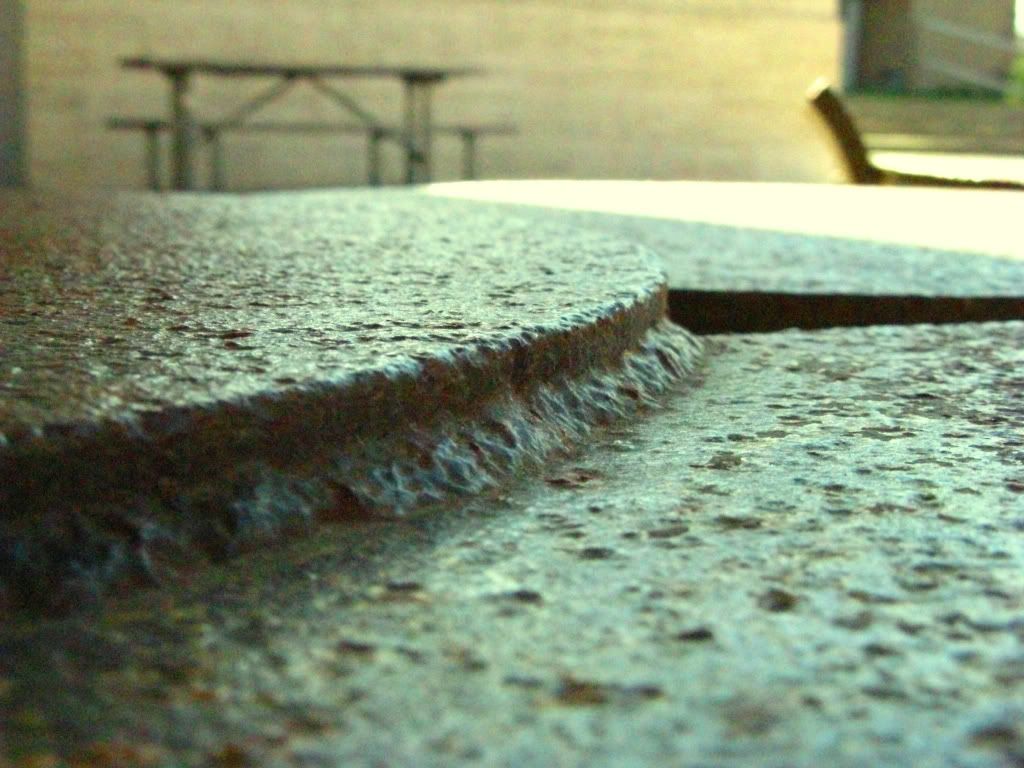
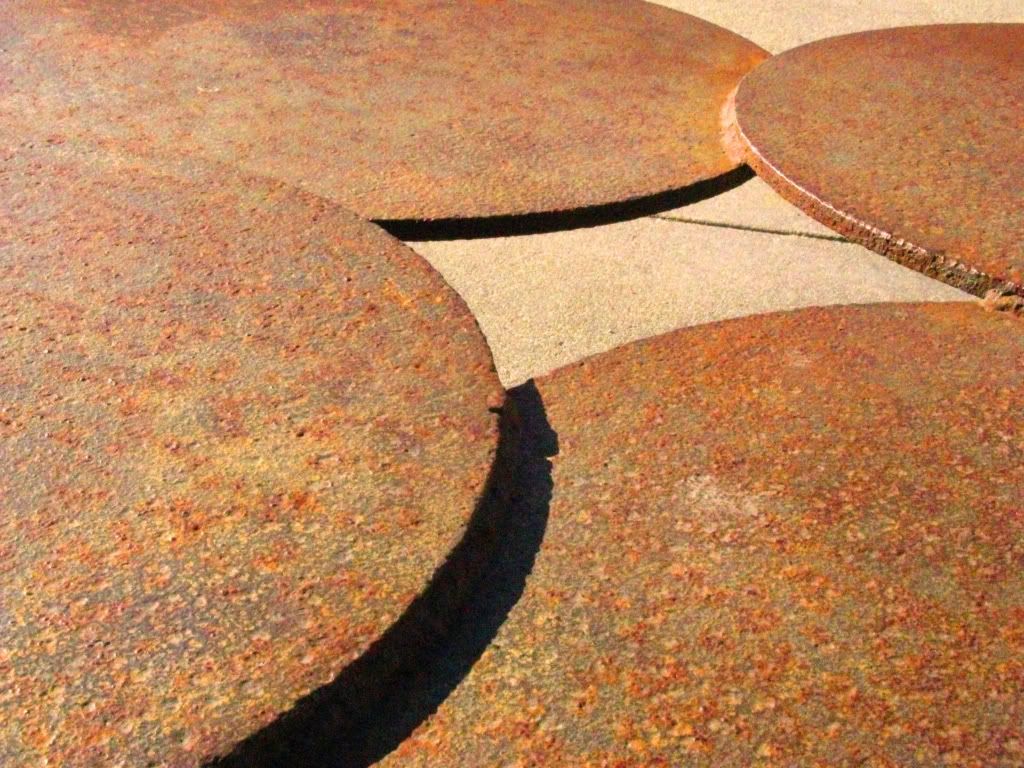
The material and the manner in which Monet's Table was assembled is representative of Monet and the impressionist art style that Michael Todd is employing. Impressionist painters often depicted that which they were painting through the use of small, clearly visible brush strokes, sometimes even making small dots with the tip of the paint brush. As a result, a vast majority of impressionist paintings appear to be somewhat unfinished. In a similar manner, the entirety of Monet's Table is composed of a rough, bumpy steel surface, as if it were painted using small, accentuated brush strokes. The areas that were welded together when forming this art object also remain somewhat rough, causing the piece as a whole to look rather unfinished. This is also supported by the minimal level of detail shown in the table. In general, lily pads are more distinguished than a simple, flat circle. However, to impressionists, the importance of shape and fine details doesn't even come close to rivaling the significance of colors and lighting effects. Michael Todd's goal here was not to create a steel replica of lily pads, but rather to create an impression of lily pads.
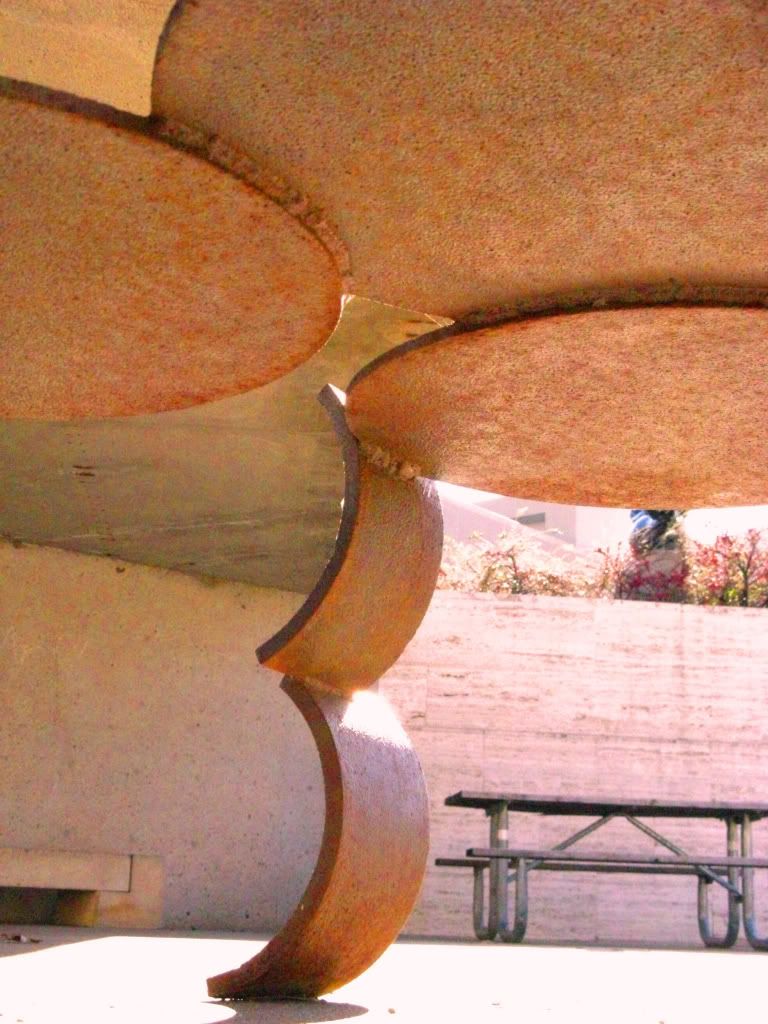
Monet's Table is strategically placed in a somewhat social area on campus, outnumbered by surrounding picnic tables and benches. These picnic tables and benches create visual unity through repetition. The title of this art object bluntly suggests that it is a table. However, its appearance differs greatly to that of the picnic tables; its top surface is made of circular panels, its legs are oddly shaped, and it is much too low to the ground. In fact, its height is similar to that of the benches in the area, making it sort of an awkward place to carry out table-bound activities. All of these characteristics contradict the utility of this art object as a table, stressing the fact that this "table" was designed for more than just a surface for eating. Also, Monet's Table is planted on a rather dull, concrete ground. The hue of the concrete contrasts with that of the art object, causing the audience to see, from many angles, merely the image of various darker circles overlaying the lighter ground. From the part of the title "(from the Lilypad Series)" the audience can gather that this image is actually more of an impression of lily pads gently floating on a still pond. Monet, who's name is a vital part of this art object's title, created a large series of paintings based around a water lily pond that he owned. Michael Todd seems to suggest that, of the tables that Monet might have owned, Monet's Table should have been a member of his collection; after all, the impressionist art style and lily pads both seem to be two of Monet's most pronounced attributes.

In addition to the aforementioned environmental characteristics, a bridge runs overhead, casting a definitive shadow across the surface of the table whenever the weather creates the right conditions. Coincidentally, the effects of lighting and shadows play a large role in the impressionist art style. Colors and lighting effects are among the most important aspects of Monet's paintings. To further support this, the bridge's shadow doesn't completely cover the table, allowing the table itself to produce a shadow on the ground. Additionally, because the table is in a public location, the audience members themselves can cast shadows upon the table and the ground near the table. Clearly, Michael Todd is using logos as he creates as many interesting shadows as possible, supporting a definitive point of both Monet and the impressionist art style. Of course, these shadows appear to change completely depending on when Monet's Table is viewed and from where the audience views it.

Monet and many other impressionist painters would often return to a location more than once just to paint the same scene from a different viewpoint, during a different season, or simply at a different time of day. Monet most noticeably did this as he painted several pictures of his water lily garden over a course of thirty years. Monet once said "I know that to paint the sea really well, you need to look at it every hour of every day in the same place so that you can understand its way in that particular spot and that is why I am working on the same motifs over and over again, four or six times even" (artquotes). Just as Monet depicted these varying effects of lighting through a multitude of paintings, so to does Michael Todd through the placement of Monet's Table. The outdoors environment reflects these changes upon Todd's art object quite noticeably. As the day progresses, the shadow from the overhead bridge slowly moves across the top surface of the art object. Furthermore, as the year progresses, all sorts of different lighting occasions make themselves present through both seasonal and weather changes. Still further, over a much longer period of time, the art object as a whole changes color with the production of rust due to its material composition.

Michael Todd has created a work of art that not only employs the impressionist art style, but uses it in ways that highlight the particular usefulness of the three-dimensional art object genre. Monet created several depictions of specific locations with varying lighting effects which, as a result, generates a unique pathos in each painting. On the other hand, Michael Todd chose to create a singular art object and place it in a location that, due to its unique lighting situations, Monet and other impressionists might find appealing. Todd effectively uses the audience, their viewpoint, and the environment as a part Monet's Table itself, which generates a different pathos depending on at what time and from what location the audience views it. In a way, Todd creates multiple art objects in just one composition, generating an array of pathos in a manner similar to that of Monet and his paintings.


Works Cited

Pioch, Nicolas. "Impressionism" June 19, 2006. WebMuseum, Paris <http://www.ibiblio.org/wm/paint/glo/impressionism/>.

artquotes.net. "Claude Monet Quotes" 2009. ArtQuotes.net <http://www.artquotes.net/masters/monet-claude-quotes.htm>.

Sunday, December 6, 2009

WP3: Rough Draft 1

Impressionism was a major movement in paintings, sculpture, and even music, and was founded by the famous painter, Claude Oscar Monet, for whom the above art object is titled. Perhaps most prominent in paintings, the impressionist style is best known today for its attempt at recreating "visual reality in terms of transient effects of light and colour" (Pioch 1). In his art object, "Monet's Table (from the Lilypad Series)," Michael Todd uses various techniques to imitate this impressionist art style, which is supported by certain characteristics only present in three dimensional works of art such as sculpture. Specifically, the art object's position in its environment is used in a near limitless number of ways to achieve this effect, reflecting its forever-changing surroundings upon its audience. Additionally, the material used in the crafting of this art object helps to support the overall impressionist imagery of this piece. Last, but certainly not least, "Monet's Table (from the Lilypad Series)" itself is altered in both minute and extreme cases by another significant dimension: Time. The intricate combination of these characteristics--all unique properties of dynamic, three-dimensional art--work together to contribute to Michael Todd's employment of the impressionist art style, which is most popularly known for its application in paintings.

"Monet's Table (from the Lilypad Series)" is strategically placed in a somewhat social area on campus, outnumbered by surrounding picnic tables and benches. These picnic tables and benches create visual unity through repetition. The title of this art object bluntly suggests that it is a table. However, its appearance differs greatly to that of the picnic tables; its top surface is made of circular panels, its legs are oddly shaped, and it is much too low to the ground. In fact, its height is similar to that of the benches in the area, making it sort of an awkward place to carry out table-bound activities. All of these characteristics contradict the utility of this art object as a table, stressing the fact that this "table" was designed for more than just a surface for eating. Also, the art object is planted on a rather dull, concrete ground. The hue of the concrete contrasts with that of the art object, causing the audience to see, from many angles, merely the image of various darker circles overlaying the lighter ground. From the part of the title "(from the Lilypad Series)" the audience can gather that this image is actually more of an impression of lily pads gently floating on a still pond. Monet, a vital part of this art object's title, created a large series of paintings based around a water lily pond that he owned. Michael Todd seems to suggest that, of the tables that Monet might have owned, "Monet's Table (from the Lilypad Series)" should have been a member of his collection; after all, the impressionist art style and lily pads both seem to be Monet's two favorite things.

In addition to the aforementioned environmental characteristics, a bridge runs overhead, casting a definitive shadow across the surface of the table whenever the weather creates the right conditions. Coincidentally, the effects of lighting and shadows play a large role in the impressionist art style. The bridge's shadow, however, doesn't completely cover the table, allowing the table itself to produce some shadow on the ground. Clearly, Michael Todd is using logos to create as many interesting shadows as possible, supporting a definitive point of both Monet and the impressionist art style.

The material and the manner in which it was assembled is also representative of Monet and the impressionist art style that Michael Todd is employing. Impressionist painters often depicted that which they were painting through the use of small, clearly visible brush strokes, sometimes even making small dots with the tip of the paint brush. As a result, a vast majority of impressionist paintings appear to be somewhat unfinished. In a similar manner, the entirety of "Monet's Table (from the Lilypad Series)" is composed of a rough, bumpy surface, as if it were painted on using small, visible brush strokes. The areas that were welded together when forming this art object also remain somewhat rough, causing the piece as a whole to look rather unfinished. This is also supported by the minimal level of detail shown in the table. In general, lily pads are more distinguished than a simple, flat circle. However, to impressionists, the importance of shape and fine details doesn't even come close to rivaling the significance of colors and lighting effects. Michael Todd's goal here was not to create a steel replica of lily pads, but rather to create an impression of lily pads.

Monet and many other impressionist painters would often return to a location more than once just to paint the same scene from a different viewpoint, during a different season, or simply at a different time of day. Monet most noticeably did this as he painted several pictures of his water lily garden over a course of thirty years. Monet once said "I know that to paint the sea really well, you need to look at it every hour of every day in the same place so that you can understand its way in that particular spot and that is why I am working on the same motifs over and over again, four or six times even." Just as Monet depicted these varying effects of lighting through a multitude of paintings, so to does Michael Todd's placement of "Monet's Table (from the Lilypad Series)." The outdoors environment reflects these changes upon Todd's art object quite noticeably. As the day progresses, the shadow from the overhead bridge slowly moves across the top surface of the art object. Furthermore, as the year progresses, all sorts of different lighting occasions make themselves present through both seasonal and weather changes. Still further, over a much longer period of time, the art object as a whole changes color with the production of rust due to its material composition.

Michael Todd has created a work of art that not only employs the impressionist art style, but uses it in ways that highlight the particular usefulness of the three-dimensional art object genre. Monet created several depictions of specific locations with varying lighting effects which, as a result, generates a unique pathos in each painting. On the other hand, Michael Todd chose to create a singular art object and place it in a location that, due to its unique lighting situations, Monet and other impressionists might find appealing. Todd effectively uses the audience, their viewpoint, and the environment as a part "Monet's Table (from the Lilypad Series)" itself, which generates a different pathos depending on at what time and from what location the audience views it.


Works Cited

Pioch, Nicolas. "Impressionism" June 19, 2006. WebMuseum, Paris <http://www.ibiblio.org/wm/paint/glo/impressionism/>.

artquotes.net. "Claude Monet Quotes" 2009. ArtQuotes.net <http://www.artquotes.net/masters/monet-claude-quotes.htm>

Friday, December 4, 2009

WP3: Statement of Purpose

The goal of my essay is to show the audience the many techniques used by Michael Todd, the author of "Monet's Table (from the Lilypad Series)," to emulate the artistic style and persona of Claude Monet. Beginning from what I believe to be the most important technique, the position of this art object in its environment plays a crucial role in demonstrating the impressionist art style of Monet. As a result, the environment is nearly as important as the piece of art. The environment is constantly changing, creating different lighting situations, different seasons, and so on. This is an important trait to the impressionist art style. Additionally, the material--it's color and texture, are important for the same reasons.

I found a website full of famous Monet quotations, some of which I want to use in support of my argument. For example, "I know that to paint the sea really well, you need to look at it every hour of every day in th
e same place so that you can understand its way in that particular spot and that is why I am working on the same motifs over and over again, four or six times even." This quotation could be helpful in explaining the impressionist emphasis on lighting and how it all relates to Michael Todd's work of art. It also shows Monet's reasons for creating the lengthy series of paintings depicting waterlilies.

Another interesting subject that could be worth some discussion is the noticeable differences between the surface of the table and the legs. The top surface is composed entirely of uniform circular plates, creating visual unity through the symbolic use of the circle. On the other hand, the legs are made of varying shapes and sizes. In effect, the legs are what makes this piece of art appear to be a real table while the top surface greatly enhances the emphasis on the impressionist art style. I could compare and contrast these two elements of the sculpture to help show Michael Todd's use of impressionism in the piece.

Lighting is one of the most important aspects in Monet's paintings. Monet used a combination of lighting and differing viewpoints within his paintings in order to generate certain pathoses. Monet's art style is reflected through the placement of Michael Todd's "Monet's Table." The table is strategically placed under a bridge so that, as the sun moves through the sky, the shadow of the bridge moves across across the surface of the table. This alone emphasizes Monet's attention to lighting. Also, the table is placed in an area from which there are many unique viewpoints; it can be viewed from below, from nearly every direction at ground level, and even from above on the bridge. Michael Todd clearly wanted to reflect the highlights of Monet's art style through his own piece.

Monday, November 30, 2009

WP3: Context

As the title of my assigned art object--"Monet's Table (from the Lilypad Series)"--suggests, Monet is an extremely important aspect to the arguments that are being made. Monet, also known as Claude Oscar Monet, was a famous French painter who founded the impressionist style of painting. Impressionist painters and their paintings often, if not always, focused on lighting and how it changes with the passing of time. This makes a lot of sense with respect to Michael Todd's "Monet's Table (from the Lilypad Series). As I've mentioned in previous posts, my assigned art object is positioned under a bridge so that, as the day progresses, the shadow from the bridge moves across the top surface of the table. This unique position under the bridge effectively portray's Monet's impressionist art style through the passing of time and motion of shadows.

Another characteristic of the impressionist style of painting is the tendency to include visible brush strokes. In some extreme cases, impressionist paintings appear as a mass of small, brightly colored strokes, only comprehendible when the painting is viewed as a whole rather than a small section. This style is also reflective of Michael Todd's piece of art; the entirety of "Monet's Table (from the Lilypad Series)" is composed of a rough, bumpy steel surface. Additionally, Michael Todd let remain clearly visible the points at which different sections of the table were welded together. This sort of rough, unfinished appearance parallels the impressionist style, making the table seem as if it had been created by Monet himself

Claude Monet is well known for his series of paintings based around the water lilies in his flower garden. Overall, he created around 250 oil paintings in this area over a span of about 30 years. It is easy to see why Michael Todd argues that Monet would have had a table of water lilies. Todd effectively converts Monet's impressionist style in paintings to his own impressionist style in sculpture. The upper surface of the table is composed of simple, circular panels, none of which have any sort of detail whatsoever. This once again follows the impressionist style, putting more importance on aspects such as lighting and time progression rather than the level of detail. This allows Todd to simply leave the impression of water lilies.

"Monet's Table (from the Lilypad Series)" is actually quite an odd sculpture because of its historical context. Impressionist sculptures weren't nonexistant in the impressionist era; however, impressionism is more commonly known for its founder, Monet, and for the many paintings created during its time. Michael Todd tries to take what Monet has created in paintings, and form it into his own piece of art to sum up all that is Monet. This conversion turns out to be rather interesting. We don't need 250 paintings and 30 years just to experience this table; we can see it from any viewpoint and at any time of the day, and it will probably always have the level of detail that it might have if it were instead one Monet's paintings.

WP3: Pre-Writing Assignment 4

My assigned sculpture, "Monet's Table (from the Lilypad Series)," can definitely be though of as both an intensification of the natural environment in which it is found and an intensification of an art object. These assertions are supported partly by the fact that it is a sculpture--a three dimensional object--that the audience can observe from a near limitless multitude of viewpoints. From these points of view, the audience can clearly see each way the environment impacts this table, and, in a similar manner, how the table effects the environment. In many cases, it is the environment itself that helps to reveal this piece of art as an intensification of an art object. "Monet's Table(from the Lilypad Series)," is more than just a table or a piece of art; it is an integral part of the environment--it is the environment.

Sculptures are, generally speaking, an intensified form art. Sketches and paintings, for example are both two-dimensional; no matter the angle at which the audience views a pencil sketch or painting, it will always look relatively the same. Sculptures, however add another dimension, allowing the audience to freely move around the piece of art, thus changing the perspective and presenting opportunities for entirely different interpretations of the art object. In the case of "Monet's Table (from the Lilypad Series)," this characteristic of three-dimensional art holds true; the table can be viewed from every side, from underneath (if you really have that much determination), and on a bridge from above. Sculptures also extend the depths of some aspects not available to paintings and pencil sketches: Material. While paintings and pencil sketches can be created on a few different materials, the sketches themselves will always be drawn in pencil and paintings (with just a bit more flexibility) will always be created in paint. Sculptures, on the other hand, can be made in basically any material imaginable, such as wood, various metals, or Play Dough! This affects such aspects as texture, temperature, weight, and color.

Both the environment and "Monet's Table (from the Lilypad Series)" impact each other in important ways. The area around this piece of art has a plethora (I really wanted to use that word) of picnic tables, creating visual unity. Michael Todd's sculpture breaks this unity with a table that contrasts in shape, size, and material, highlighting its most important aspects. The environment is continuously reflected upon "Monet's Table (from the Lilypad Series)" mostly because of its strategic position under a bridge. Because of this placement, the balance between sunlight and shadow constantly shifts in an epic battle played out across the surface of the table. Clearly, another dimensions is present: Time. The outdoor setting of this art object allows time to constantly alter its appearance, temperature, and--in the long run--structural integrity. These aspects reflect the effects of the environment to the audience. In this case, "Monet's Table (from the Lilypad Series)" as an intensification of an art object is highlighted by its intensification of the environment.

Sunday, November 22, 2009

WP3: Pre-Writing Assignment 3


I think the setting of my assigned art object, Monet's Table (from the Lilypad Series), is extremely important to its argument. When a piece of art is located inside of a building, its surroundings are, for the most part, static; a few adjacent pieces of art might be swapped for something else every once in a while, but that's it. Outdoors, however, an art object's surroundings are subject to drastic changes. The weather is always a factor; it could be rainy, snowy, foggy, sunny, and so on. The time of day is also important. Anyone can view these outdoor objects at any time of the day, but the same can't be said about the art located within the museum. All of these factors directly support important characteristics of Monet, after which this piece was titled. Monet often created numerous paintings of a location seen from different viewpoints, paying close attention to the lighting. He would sometimes return to the same location at different times of the year to paint the same landscape during a different season.

Lighting is one of the most important aspects in Monet's paintings. Monet used a combination of lighting and differing viewpoints within his paintings in order to generate certain pathoses. Monet's art style is reflected through the placement of Michael Todd's "Monet's Table." The table is strategically placed under a bridge so that, as the sun moves through the sky, the shadow of the bridge moves across across the surface of the table. This alone emphasizes Monet's attention to lighting. Also, the table is placed in an area from which there are many unique viewpoints; it can be viewed from below, from nearly every direction at ground level, and even from above on the bridge. Michael Todd clearly wanted to reflect the highlights of Monet's art style through his own piece.

The title of this piece, "Monet's Table," practially asks the audience to view this not as a piece of art, but as a simple table. That being said, it makes for a rather unique table. For one, it's composed entirely of steel, which, especially when located outside, is subject to rusting. Additionally, steel isn't exactly the most inviting material for a table; it can get extremely hot when placed in the sun, or it can be freezing when covered by shade. Also, the top surface of this "table" is bumpy and has rather large gaps created by the spacing between the "lily pads." All of these characteristics of this "table" sort of contradict the general purposes of a table. No one wants to write papers on or eat food over a rusty, holey table that doesn't even have any chairs to sit on. By creating this piece of art that contradicts the mainstream ideas of tables, Michael Todd almost seems to be poking fun at Monet's obsession with lily pads in his series of paintings centered on a lily pad pond. In my opinion, Todd seems to argue that this "table" should have belonged to Monet because of his numerous paintings of lily pads.

Wednesday, November 18, 2009

WP3: Cursory Analysis

My assigned art object is titled "Monet's Table (from the Lilypad Series)." It was created by the artist Michael Todd (left), who sculpts with a variety of materials including wood, steel, bronze, and clay. In this case, Todd uses steel to compose this entire piece of art. As the name suggests, Monet's Table takes the form of an actual table; however, it's shaped a bit differently than most modern tables. The top surface is formed buy two layers of circular panels. The top layer overlaps parts of the bottom layer, and various empty spaces are present between each of the circular panels. The table is held up by three legs, each forming a different shape. The most interesting leg, in my opinion, is made of two arcs, reaching past the top surface of the table, welded to the outer edge. The next leg is a somewhat wide cylinder, only half of which can be seen from above the table. The last leg, perhaps the least interesting, was a simple, flat rectangle; it was, however, positioned in an odd manner so that just a corner was attached to the top of the table.

I think the most important aspect of all these pieces is the contrast between the top of the table and the legs. The top surface of the table creates visual unity through repition of shapes, or, or specifically, circular panels. The legs of the table break this visual unity via contrasting shapes. The color, texture, and material, on the other hand, support this uniformity of the table; the entire steel piece is grey and a bit rusted, giving it a weathered appearance.

Another important aspect of this piece is its position amongst its surroundings. First of all, there are many picnic tables and benches in the area, which can signify that this location is one of social gathering--a place to meet and look at the art perhaps. However, Monet's table is placed lower than the picnic tables, giving it more of a coffee table appearance. It's cold, rough, and jagged, which makes it sort of uninviting, contradicting its purpose as a table.

More importantly, I feel, the table is positioned half way under a bridge. I noticed that, even as I sat and observed this piece of art, the shadow that was cast by the bridge slowly moved across the surface of the table as the sun moved through the sky, emphasizing the changing environment in which the table is placed. I'm not sure if it was positioned under the bridge for this reason, but it might have some importance to the context. The title here is extremely important. Monet was a famous artist who advocated the Impressionist style in his paintings. Also, as the title of this art object suggests, Monet created a series of paintings depicting water-lilies. From this, I can understand that the circular steel panels making the tabletop are supposed to be lily pads. Perhaps the lack of detail in these lily pads is an important aspect of Impressionism?

Sunday, November 15, 2009

WP3: Pre-Writing Assignment 1:

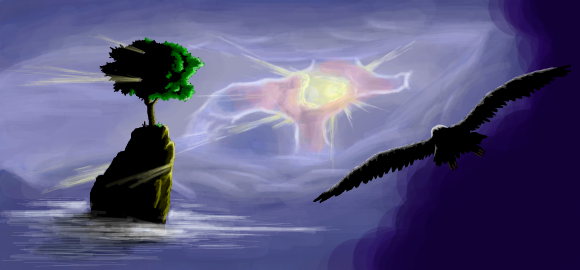
I am a huge fan of art. I've often thought about getting some sort of art major here at UNL, which is quite a big jump from computer engineering, but I suppose I am content with simply creating my art in my own free time. In any case I haven't actually had too much experience with art-objects. I most certainly have had absolutely no experience rhetorically analyzing art-objects outside of this English class, and I suppose nothing that I've created makes any form of argument in a manner similar to that of "Breach," though I have tried to give some of my most recent works art a bit more meaning; apparently this English course has influenced me to some extent.

Most of my experience with art-objects is composed of simple art classes in high school such as Intro to Art and Graphic Design courses. In Intro to Art I mostly dealt with a weekly sketching assignment, in-class water-color paintings, sculptures, and other random activities. In Graphic Design I simply learned how to use photoshop by editing some pictures. In retrospect, neither of these courses did much to contribute to my abilities as an artist. It seems to me that I've learned a lot more by simply drawing in my own free time. That said, most of my "art-objects" are simply pencil sketches, but I also enjoy creating Facebook graffitis using the graffiti application.

None of my artwork is by any means "professional," but I always enjoy creating pictures like this. Art is, for the most part, a way for me to relax and let my imagination run free. I used to simply draw realistic pictures or events, but lately I've been drawing slightly more abstract pictures merely because it allows me to experiment with a greater range of ideas. Whether I be doodling in class or dedicating a time-consuming graffiti to a friend, art will always simply be a way for me to free my mind and escape from reality.

Friday, November 13, 2009

WP2: Final Draft

Author's Note:

From Rough Draft 1 to Rough Draft 2, I made only a couple of modifications due to constraints on time; however, the changes that I made are rather important to the content of my final draft. After rereading my essay a couple more times, I conclude that the paragraph beginning "The facial expressions of the two characters..." clearly did not fit into my essay since most of my essay's content revolved around the unique use of panels. After removing this paragraph I decided to "beef up" the paragraph before it that talked about the use of hues in certain groups of panels. This paragraph felt extremely underdeveloped to me because I never actually connected it to the context or the argument when I first wrote it. Thus, I nearly doubled it's length by adding these connections, using language from our textbook and giving it far more importance than it had originally. For example, I talk about "visual unity using repetition of hues in each panel," and I state that it contributes to logos.

The second to last paragraph about the symbolic use of the pterodactyl also seemed to fit rather awkwardly into my essay, but I felt like it covered an important concept that needed to be discussed. Thus, from my second draft to my final draft, I completely removed the paragraph, but inserted the important concepts into parts of the essay that helped to support it. For example, I altered the sentence beginning with "Through this dream Calvin is fulfilling his wish to fly..." by dividing it into two sentences and adding "Calvin is fulfilling his wish to be free from reality just as the pterodactyl is free from the confines of gravity." I didn't directly mention symbolism because that is an entirely different rhetorical element that would subtract from the purpose of the paragraph; I simply wanted the audience to see how the pterodactyl is being used in Calvin's dream.

I also worked a bit on transitions from paragraph to paragraph. At the end of the paragraph beginning with "The concepts of..." I added a final sentence "This relationship is clearly shown through the alignment of panels." This sentence connects the relationship between dreams and denial to the alignment of the panels, helping to transition from one paragraph to the next. At this point, I felt as if the body of the essay had improved enough, so I turned my attention to the conclusion after running through one last time to tweak word choices and correct a few grammar mistakes. My conclusion felt like it simply brought the essay to a halt rather than actually conclude with a meaningful sentence. Thus, I tried to finish with something a little more powerful: "No matter how hard Calvin the pterodactyl flaps his wings, will he ever truly be free from the gravity of his unpleasant situation?" I could have simply inserted this as a statement, but I feel that leaving it in the form of a question allows the conclusion to relate more closely to the audience, which is the overall goal of my conclusion.

Rough Draft 2
Rough Draft 1
Statement of Purpose


Final Draft:

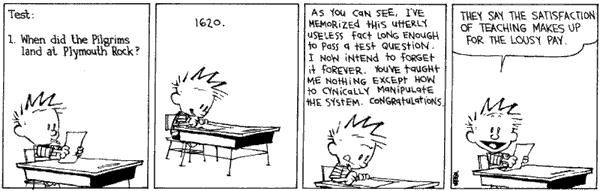
Denial is a common defense mechanism that is often viewed as a potentially harmful method of coping with anxiety. Through this comic strip, Bill Watterson uses humor to show some of the more serious effects of denial, revealing a thin line between the active use of the imagination and this harmful defense mechanism. Watterson uses a unique arrangement of the panels in this comic strip to guide the audience through an otherwise unclear path. This arrangement leads the audience to make comparisons between different frames of the comic and, in a similar fashion, the different uses of denial. Within this arrangement Watterson uses aspects such as the level of detail, size of the panels, and different hues to show extensively the contrast between dream and reality.

The concepts of denial, dreams, and the imagination are all important aspects of psychoanalysis, a comprehensive theory of human nature and behaviour. Sigmund Freud, a famous neurologist who developed much of what we know to be the theory of psychoanalysis, theorized that dreams are basically a "fulfillment of wishes" (Chiriac 5). This can be clearly seen in the comic strip, where Calvin daydreams that he is a pterodactyl. Through this dream, Calvin is fulfilling his wish to fly and to be a dinosaur. More importantly, however, Calvin is fulfilling his wish to be free from reality just as the pterodactyl is free from the confines of gravity. Coincidentally, denial, another concept originating from the theories of Freud, "entails ignoring or refusing to believe an unpleasant reality" (Encyclopedia of Mental Disorders 3). Calvin, as he says himself, is in a state of denial. Calvin chooses to ignore the "unpleasant reality" of his geography class through the act of daydreaming--or imagining himself flying around as a pterodactyl in prehistoric times. Thus, Calvin's dream, a product of his vivid imagination, is directly related to the denial of his unpleasant reality. This relationship is clearly shown through the alignment of panels.

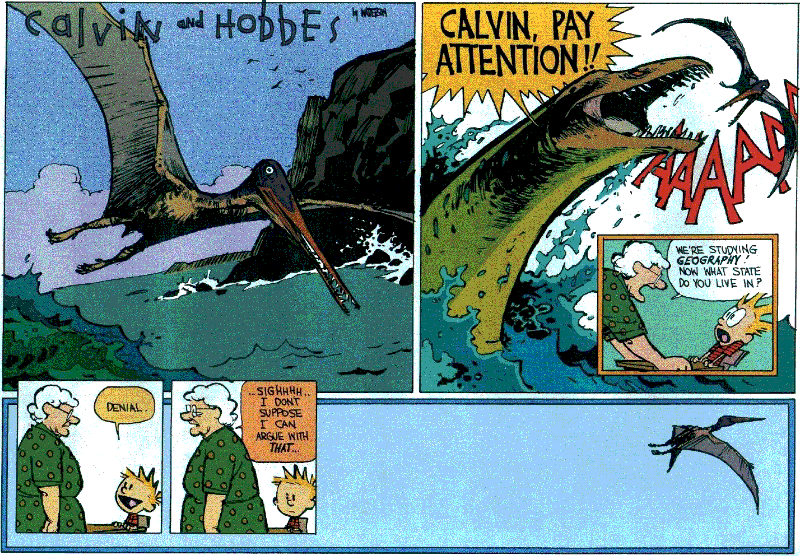
Bill Watterson is well known for using unique arrangements of panels in his comic strips. For example, in this strip, none of his panels are aligned and some of them are even tilted. Similarly, panels in the primary comic overlap one another and are greatly varied in proportions. Watterson uses this unique setup to both help support the purpose of his comic and to ensure that the audience is guided along the intended path of his comic strip, moving from one panel to the next. As a result of this setup in the primary comic, a sort of background and foreground is produced. The background is filled with all of the panels that resemble Calvin's daydream while the foreground is composed of a few panels depicting his reality. This structure creates a logos that demonstrates the focus on reality over imagination; generally speaking, the foreground is the main focus rather than the background, and this comic is reflective of that. However, the differences between these two elements contradict the logic of this structure, demonstrating the effects of denial.

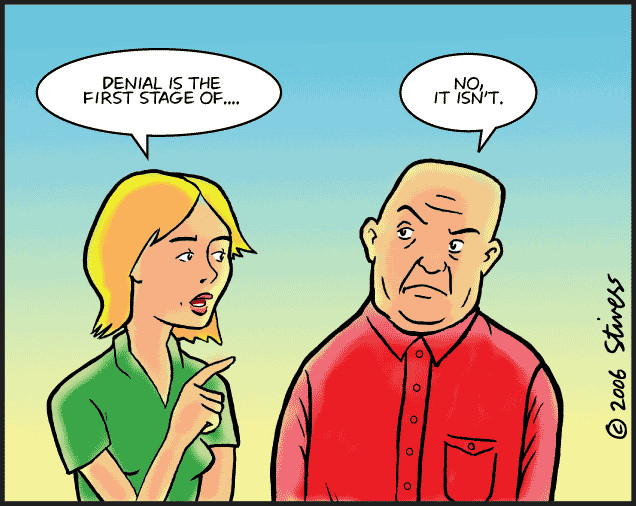
Watterson strengthens his argument by creating several differences between the background and foreground besides the fact that one represents fantasy while the other shows reality. The panels displaying Calvin's imagination are enlarged to the point that they cover the entire strip, while the panels depicting reality are notably smaller, and overlapping the background panels. Additionally, the panels in the background show much more detail than those of the foreground through aspects such as shading and the overall number of hues. The difference in size and detail of these panels not only emphasize the extent of Calvin's imagination, but also reflect Calvin's rejection, or denial, of the reality in which he is trapped. Truly, throughout this entire strip, Calvin's imagination seems to carry much more importance than his reality. The above comic strip uses a similar method, enlarging the pieces of Calvin's imagination and giving them more detail. In both cases we could conclude that Calvin either has a vivid imagination or that he lives in denial, in his own little world.

The author's choice of hues plays a crucial role in emphasizing the contrast between fantasy and reality. In the majority of the panels depicting dinosaurs, the background is filled with shades of blue. On the other hand, the background is completely white in the two reality-based panels located at the bottom left of the strip. This creates visual unity using repetition of hues in each panel, causing the remaining two panels to contrast with the rest of the comic; the hues are completely swapped in these two panels where Calvin is called out of the daydream by his teacher, showing a transition from dream to reality. This logos causes the audience to make a comparison between these two panels. Additionally, the two panels in the upper right are split in nearly the same way by a white sky in one and a white speech bubble in the other, linking the two panels together and further helping to lead the audience into making a comparison. Because one panel is positioned in front of the other, the two panels share an extremely close relationship. From this, the audience can clearly see that Calvin is the pterodactyl and his teacher is the dinosaur that's coming out of the water. All of these aspects support the juxtaposition being used by the author, showing the similarities between two completely opposite concepts: Imagination and reality.

Calvin is well known for having an active imagination; after all, the "Calvin and Hobbes" comic strip series is almost always centered around the adventures of both Calvin and his imaginary talking tiger friend, Hobbes; it could be assumed that Calvin lives in denial of the fact that he has no real friends. Defense mechansims such as denial are often regarded as "potentially maladaptive behavioral patterns that may lead to psychological disorders" (Encyclopedia of Mental Disorders 3). Does this mean that Calvin lives in denial with the threat of developing a psychological disorder, or is Calvin simply a child who likes to fantasize about dinosaurs and flying through the clouds? Should these two ideas be regarded as one and the same? These are the questions that Watterson's comic forces us to ask ourselves. Most people who see this comic strip have probably experienced a situation similar to that of Calvin--sitting in a boring class at school and letting the mind wander far away. As a result we can easily connect to the strip and apply it to ourselves. Most of us have probably never considered ourselves to be in a state of denial for simply daydreaming or imagining ourselves elsewhere. Nonetheless, the effects of both denial and daydreaming can be viewed in the same manner. No matter how hard Calvin the pterodactyl flaps his wings, will he ever truly be free from the gravity of his unpleasant situation?


Works Cited

Chiriac, Jean. "Dream Interpretation and Psychoanalysis." 2009. AROPA <http://freudfile.org/psychoanalysis/dream_interpretation_and.html>.

Encyclopedia of Mental Disorders. "Denial." 2009. Advameg, Inc. <http://www.minddisorders.com/Del-Fi/Denial.html>

Wednesday, November 11, 2009

WP2: Rough Draft 2

Denial is a common defense mechanism that is often viewed as a potentially harmful method of coping with anxiety. Through this comic strip, Bill Watterson uses humor to show some of the more serious effects of denial, revealing a thin line between the active use of the imagination and this harmful defense mechanism. Watterson uses a unique arrangement of the panels in this comic strip to guide the audience through an otherwise unclear path. This arrangement leads the audience to make comparisons between different frames of the comic and, in a similar fashion, the different uses of denial. Within this arrangement Watterson uses aspects such as the level of detail, size of the panels, and typography to show extensively the contrast between dream and reality.

The concepts of denial, dreams, and the imagination are all important aspects of psychoanalysis, a comprehensive theory of human nature and behaviour. Sigmund Freud, a famous neurologist who developed much of what we know to be the theory of psychoanalysis, theorized that dreams are basically a "fulfillment of wishes" (Chiriac 5). This can be clearly seen in the comic strip, as Calvin daydreams that he is a pterodactyl. Through this dream Calvin is fulfilling his wish to fly, to be a dinosaur, or, more importantly, to escape reality. Coincidentally, denial, another concept originating from the theories of Freud, "entails ignoring or refusing to believe an unpleasant reality" (Encyclopedia of Mental Disorders 3). Calvin, as he says himself, is in a state of denial. Calvin chooses to ignore the "unpleasant reality" of his geography class through the act of daydreaming--or imagining himself flying around as a pterodactyl in prehistoric times. Thus, Calvin's dream, a product of his vivid imagination, is directly related to the denial of his unpleasant reality.

Bill Watterson is well known for using unique arrangements of panels in his comic strips. For example, in this strip, none of his panels are aligned and some of them are even tilted. Similarly, panels in the primary comic overlap one another and are greatly varied in proportions. Watterson uses this unique setup to ensure that the audience follows a strict path through the comic strips, moving from one panel to the next and to help support the purpose of the comic. As an effect to this setup in the primary comic, a sort of background and foreground is produced. The background is filled with all of the panels that resemble Calvin's daydream while the foreground is composed of a few panels depicting his reality. This creates a structure that feels logical. Generally speaking, the foreground is the main focus rather than the background, and this comic is reflective of that. However, the differences between these two elements contradict the logic of this structure, demonstrating the effects of denial.

Watterson strengthens his argument by creating several differences between the background and foreground besides the fact that one represents fantasy while the other shows reality.
The panels displaying Calvin's imagination are enlarged to the point that they cover the entire strip, while the panels depicting reality are notably smaller, and overlapping the background panels. Additionally, the panels in the background show much more detail than those of the foreground through aspects such as shading and the overall number of hues. The difference in size and detail of these panels not only emphasize the extent of Calvin's imagination, but also reflect Calvin's rejection, or denial, of the reality in which he is trapped. Truly, throughout this entire strip, Calvin's imagination seems to carry much more importance than his reality. The above comic strip uses a similar method, enlarging the pieces of Calvin's imagination and giving them more detail. In both cases we could see that Calvin has a vivid imagination or that he lives in denial, in his own little world.

The author's choice of hues plays a crucial role in emphasizing the contrast between fantasy and reality. In the majority of the panels depicting dinosaurs, the background is filled with shades of blue. On the other hand, the background is completely white in the two reality-based panels located at the bottom left of the strip. This creates visual unity using repetition of hues in each panel, causing the remaining two panels to contrast with the rest of the comic; the hues are completely swapped in these two panels where Calvin is called out of the daydream by his teacher, showing a transition from dream to reality. This logos causes the audience to make a comparison between these two panels. Additionally, the two panels in the upper right are split in nearly the same way by a white sky in one and a white speech bubble in the other, linking the two panels together and further helping to lead the audience into making a comparison. Because one panel is positioned in front of the other, the two panels share an extremely close relationship. From this, the audience can clearly see that Calvin is the pterodactyl and his teacher is the dinosaur that's coming out of the water. All of these aspects support the juxtaposition being used by the author, showing the similarities between two completely opposite concepts: Imagination and reality.

Watterson uses the prehistoric bird and the concept of flight itself as a symbol of freedom. Calvin, out of complete boredom, denies his own existence in the classroom, thus freeing his mind just as the pterodactyl in the comic strip is free from the limits of gravity. Psychoanalytically, this means that Calvin is in denial because he ignores the reality of his geography class by daydreaming in order to fulfill his wish of being free. At a glance, this might seem completely fine, but has Calvin solved his problem, truly freeing himself from his unpleasant reality? In the very last frame, the pterodactyl can be seen drifting along, continuing its flight; Calvin has once again returned to his dream, perhaps even as he speaks to his teacher. The two frames depicting reality overlap this final frame, suggesting that Calvin's imagination continues while he converses with his teacher.

Calvin is well known for having an active imagination; after all, the "Calvin and Hobbes" comic strip series is almost always centered around the adventures of both Calvin and his imaginary talking tiger friend, Hobbes; it could be assumed that Calvin lives in denial of the fact that he has no real friends. Defense mechansims such as denial are often regarded as "potentially maladaptive behavioral patterns that may lead to psychological disorders" (Encyclopedia of Mental Disorders 3). Does this mean that Calvin lives in denial with the threat of developing a psychological disorder, or is Calvin simply a child who likes to fantasize about dinosaurs and flying through the clouds? Should these two ideas be regarded as one and the same? These are the questions that Watterson's comic forces us to ask ourselves. Most people who see this comic strip have probably experienced a situation similar to that of Calvin--sitting in a boring class at school and letting the mind wander far away. As a result we can easily connect to the strip and apply it to ourselves. Most of us have probably never considered ourselves to be in a state of denial for simply daydreaming or imagining ourselves elsewhere.


Works Cited

Chiriac, Jean. "Dream Interpretation and Psychoanalysis." 2009. AROPA <http://freudfile.org/psychoanalysis/dream_interpretation_and.html>.

Encyclopedia of Mental Disorders. "Denial." 2009. Advameg, Inc. <http://www.minddisorders.com/Del-Fi/Denial.html>

Sunday, November 8, 2009

WP2: Rough Draft 1

Denial is a common defense mechanism that is often viewed as a potentially harmful method of coping with anxiety. Through this comic strip, Bill Watterson uses humor to show some of the more serious effects of denial, revealing a thin line between the active use of the imagination and this harmful defense mechanism. Watterson uses a unique arrangement of the panels in this comic strip to guide the audience through an otherwise unclear path. This arrangement leads the audience to make comparisons between different frames of the comic and, in a similar fashion, the different uses of denial. Within this arrangement Watterson uses aspects such as the level of detail, size of the panels, and typography to show extensively the contrast between dream and reality.

The concepts of denial, dreams, and the imagination are all important aspects of psychoanalysis, a comprehensive theory of human nature and behaviour. Sigmund Freud, a famous neurologist who developed much of what we know to be the theory of psychoanalysis, theorized that dreams are basically a "fulfillment of wishes" (Chiriac 5). This can be clearly seen in the comic strip, as Calvin daydreams that he is a pterodactyl. Through this dream Calvin is fulfilling his wish to fly, to be a dinosaur, or, more importantly, to escape reality. Coincidentally, denial, another concept originating from the theories of Freud, "entails ignoring or refusing to believe an unpleasant reality" (Encyclopedia of Mental Disorders 3). Calvin, as he says himself, is in a state of denial. Calvin chooses to ignore the "unpleasant reality" of his geography class through the act of daydreaming--or imagining himself flying around as a pterodactyl in prehistoric times. Thus, Calvin's dream, a product of his vivid imagination, is directly related to the denial of his unpleasant reality.

Bill Watterson is well known for using unique arrangements of panels in his comic strips. For example, in this strip, none of his panels are aligned and some of them are even tilted. Similarly, panels in the primary comic overlap one another and are greatly varied in proportions. Watterson uses this unique setup to ensure that the audience follows a strict path through the comic strips, moving from one panel to the next and to help support the purpose of the comic. As an effect to this setup in the primary comic, a sort of background and foreground is produced. The background is filled with all of the panels that resemble Calvin's daydream while the foreground is composed of a few panels depicting his reality. This creates a structure that feels logical. Generally speaking, the foreground is the main focus rather than the background, and this comic is reflective of that. However, the differences between these two elements contradict the logic of this structure, demonstrating the effects of denial.

Watterson strengthens his argument by creating several differences between the background and foreground besides the fact that one represents fantasy while the other shows reality.
The panels displaying Calvin's imagination are enlarged to the point that they cover the entire strip, while the panels depicting reality are notably smaller, and overlapping the background panels. Additionally, the panels in the background show much more detail than those of the foreground through aspects such as shading and the overall number of hues. The difference in size and detail of these panels not only emphasize the extent of Calvin's imagination, but also reflect Calvin's rejection, or denial, of the reality in which he is trapped. Truly, throughout this entire strip, Calvin's imagination seems to carry much more importance than his reality. The above comic strip uses a similar method, enlarging the pieces of Calvin's imagination and giving them more detail. In both cases we could see that Calvin has a vivid imagination or that he lives in denial, in his own little world.

The author's choice of hues also plays an important role. In the first and last frame, where Calvin is drawn as a dinosaur, the background is filled with blue. On the other hand, the background is white in the two panels located at the bottom left of the strip. These hues are completely swapped in the other two panels where Calvin is called out of the daydream by his teacher. This helps to show that the comic is being transitioned from imagination to reality and then back again. Additionally, the two panels in the upper right are split in nearly the same way by a white sky in one and the white speech bubble in the other. This links these two panels together, forcing the audience to make a comparison. Because one panel is positioned in front of the other, the audience can clearly see that Calvin is the pterodactyl and his teacher is the dinosaur that's coming out of the water.

The facial expressions of the two characters helps the audience to more easily interpret the text. As the teacher tells Calvin to pay attention, Calvin's eyes are wide, his mouth is open as if screaming, and his hair is standing straight up. The audience can easily read his expression as one of surprise, which parallels the response of the pterodactyl being attacked by the other dinosaur. Additionally, when Calvin responds to the teacher with the simple answer "denial," he has a large smile on his face, making him look cheerful and carefree. However, when the teacher agrees with him in the next frame, his expression seems to change to that of confusion as if wondering "What did she mean by that?"

Watterson uses the prehistoric bird and the concept of flight itself as a symbol of freedom. Calvin, out of complete boredom, denies his own existence in the classroom, thus freeing his mind just as the pterodactyl in the comic strip is free from the limits of gravity. Psychoanalytically, this means that Calvin is in denial because he ignores the reality of his geography class by daydreaming in order to fulfill his wish of being free. At a glance, this might seem completely fine, but has Calvin solved his problem, truly freeing himself from his unpleasant reality? In the very last frame, the pterodactyl can be seen drifting along, continuing its flight; Calvin has once again returned to his dream, perhaps even as he speaks to his teacher. The two frames depicting reality overlap this final frame, suggesting that Calvin's imagination continues while he converses with his teacher.

Calvin is well known for having an active imagination; after all, the "Calvin and Hobbes" comic strip series is almost always centered around the adventures of both Calvin and his imaginary talking tiger friend, Hobbes; it could be assumed that Calvin lives in denial of the fact that he has no real friends. Defense mechansims such as denial are often regarded as "potentially maladaptive behavioral patterns that may lead to psychological disorders" (Encyclopedia of Mental Disorders 3). Does this mean that Calvin lives in denial with the threat of developing a psychological disorder, or is Calvin simply a child who likes to fantasize about dinosaurs and flying through the clouds? Should these two ideas be regarded as one and the same? These are the questions that Watterson's comic forces us to ask ourselves. Most people who see this comic strip have probably experienced a situation similar to that of Calvin--sitting in a boring class at school and letting the mind wander far away. As a result we can easily connect to the strip and apply it to ourselves. Most of us have probably never considered ourselves to be in a state of denial for simply daydreaming or imagining ourselves elsewhere.


Works Cited

Chiriac, Jean. "Dream Interpretation and Psychoanalysis." 2009. AROPA <http://freudfile.org/psychoanalysis/dream_interpretation_and.html>.

Encyclopedia of Mental Disorders. "Denial." 2009. Advameg, Inc. <http://www.minddisorders.com/Del-Fi/Denial.html>

Saturday, October 31, 2009

WP2: Statement of Purpose

This comic strip is all about the concept of denial. Most psychologists believe denial to be a defense mechanism than can lead to psychological disorders, but Bill Watterson, the author of this strip argues otherwise. Watterson fights against the ill-conceived notions of denial by showing that the imagination, a tool of denial, is something beneficial that we should all use more often. While Calvin looks at denial positively, his teacher represents the negative views associated with it. Like most--if not all--Calvin and Hobbes comic strips, Calvin is the character making a statement in support of Bill Watterson's personal opinions. Clearly, he supports the use of the imagination, even though it can be easily associated to denial. In the case of this comic strip, Calvin imagines himself flying through the sky as a prehistoric bird. This is shown in a positive way because birds and the concept of flight itself is often symbolic of freedom. Calvin, out of complete boredom, denies his own existence in the classroom, thus freeing his mind as the pterodactyl in the comic strip is free from the confines of gravity. Clearly, Calvin's imagination is being shown in a way that supports Watterson's views, thus generating an ethos.

To me, the most evident method of supporting my argument would be to make various comparisons between two aspects of the comic strip. First of all, the strip causes the audience to compare reality and imagination by depicting Calvin's life in small uniformly shaped panels and his imagination in larger, more detailed panels. In a likewise manner, the two frames that show Calvin's teacher yelling and bringing Calvin out of his dream state are both set up in a manner that causes the audience to make another comparison. Finally, the two panels positioned next to each other that display Calvin's reality can be used to compare the positive and negative aspects of the imagination and its role in denial. Of course, after each comparison I must also tie my sub-arguments back to the psychoanalytical context of denial.

My target audience is anyone who is either against using their imagination or who simply doesn't use it enough. In my opinion, nobody--including myself--ever uses their imagination enough (I suppose you could then say that my audience is everyone). However, my goal is not to force my own opinions onto the audience; I simply hope that a few windows are opened once the audience views Watterson's comic and sees his methods for forming his argument. Psychoanalysis, being the main context of my essay, plays a vital role in supporting my arguments; thus, I need to be certain that my research is accurate considering the fact that my audience may include people who know much about psychology. Also, Watterson's comic does nothing to disprove any theories of psychoanlysis; he is simply expressing his view on the matter. Mentioning this might be helpful in the rare case of some crazy psychologist trying to argue with Bill Watterson or my essay.

Wednesday, October 28, 2009

WP2: Pre-Writing Assignment 2

At a glance, the most noticeable portion of my primary comic strip is the enlarged frames depicting dinosaurs. However, rather than focus on the dinosaurs, this strip is centered around the fact that these frames are showing Calvin's imagination, or, more specifically, a particular daydream in his geography class. Because of this, I researched dreaming and its purpose from a psychological point of view. Sigmund Freud, a famous neurologist who developed psychoanalysis, theorized that dreams are basically a "fulfillment of wishes" (Chiriac 5). Likewise, Calvin fulfills his wish of being as free as a bird flying high in the sky. He most likely chooses a pterodactyl in prehistoric times to further distance himself from his classroom in the present.

Bill Watterson also gives the word "denial" an important role as he devotes an entire frame to the one-word answer from Calvin. Likewise, denial seems to be an important topic to Sigmund Freud in his study of psychoanalysis. According to Freud, denial is a defense mechanism that entails "ignoring or refusing to believe an unpleasant reality" (Encyclopedia of Mental Disorders 3). I think this description matches exactly with what Calvin is experiencing; he chooses to ignore his unpleasant geography class by daydreaming, imagining himself flying through the sky as a prehistoric bird.

Today, however, defense mechanisms such as denial are regarded as "potentially maladaptive behavioral patterns that may lead to psychological disorders" (Encyclopedia of Mental Disorders 3). This view is reflected through Calvin's teacher as she says "I don't suppose I can argue with that..." after Calvin suggests that he is in a state of denial. Calvin's teacher speaks of denial in a negative manner, with an annoyed expression on her face, hinting that Calvin has one of the aforementioned psychological disorders. This view completely contradicts how Calvin feels as he speaks of denial in a simplistic manner with a huge smile on his face.

I can see more clearly now that this comparison between positive and negative views of denial is meant to be made by the audience. The two panels depicting these two points of view are the only two panels placed by another panel displaying reality; the only other panel that isn't displaying Calvin's dream is positioned in front of one of the dream panels, forcing a comparison of imagination and reality. Also, the different levels of detail between panels displaying reality and those displaying Calvin's dream play a more prominent role. The panels displaying Calvin's dream appear to be more realistic than those of his reality. In a likewise manner, people experiencing denial might lose themselves in a false reality created by their very own subconscious in order to deal with a traumatic event or unsatisfactory conditions.

Calvin and Hobbes comic strips are well known for expressing Bill Watterson's opinions through the seemingly childish actions and words of his main character, Calvin. This allows Watterson to comically address issues that most likely wouldn't be comical in reality. For example, Calvin's state of denial in geography class is much more amusing to see than a case of someone who might initially experience denial after losing someone close.


Works Cited

Chiriac, Jean. "Dream Interpretation and Psychoanalysis." 2009. AROPA <http://freudfile.org/psychoanalysis/dream_interpretation_and.html>.

Encyclopedia of Mental Disorders. "Denial." 2009. Advameg, Inc. <http://www.minddisorders.com/Del-Fi/Denial.html>

Saturday, October 24, 2009

WP2: Cursory Analysis

I haven't read many Calvin and Hobbes comic strips in the past, but this one became an instant favorite of mine. Put simply, Calvin is daydreaming, imagining himself to be a prehistoric bird--a pterodactyl, perhaps--when his teacher yells at him to pay attention. The teacher asks Calvin what state he lives in, to which he happily responds "Denial". To this, the teacher agrees and walks away, leaving Calvin to once again return to his daydreaming.

Every aspect of this strip seems to weave together perfectly. I noticed quite a few techniques that are used to support the overall image of this comic. First of all, the level of detail displayed in different panels seems to play an important role. In each frame consisting of dinosaurs, the author, Bill Watterson, uses shading and detailed backgrounds to make the images feel more realistic. On the other hand, the panels displaying reality show the least amount of detail.

The arrangement and size of the panels is rather unique in this comic strip. The panels displaying Calvin's imagination are enlarged to the point that they cover the entire strip, while the panels depicting reality, are all smaller, nearly the same size, and overlapping the background panels. The size of each frame works alongside the level of detail shown in each frame in order to emphasize how expansive Calvin's imagination is, and also reflect how much he rejects the reality in which he is trapped. Truly, in this entire strip, Calvin's imagination is much more important than the reality in which he lives.

The author's choice of hues also plays an important role. In the first and last frame, where Calvin is drawn as a dinosaur, the background is filled with blue. On the other hand, the background is white in the two panels located at the bottom left of the strip. These hues are completely swapped in the other two panels where Calvin is called out of the daydream by his teacher. I think this helps to show that the comic is being transitioned from imagination to reality and then back again. Additionally, the two panels in the upper right are split in nearly the same way by a white sky in one and the white speech bubble in the other. This links these two panels together, forcing the audience to make a comparison. Because one panel is positioned in front of the other, the audience can clearly see that Calvin is the pterodactyl and his teacher is the dinosaur that's coming out of the water.

The facial expressions of the two characters helps the audience to more easily interpret the text. As the teacher tells Calvin to pay attention, Calvin's eyes are wide, his mouth is open as if screaming, and his hair is standing straight up. The audience can easily read his expression as one of surprise, which parallels the response of the pterodactyl being attacked by the other dinosaur. Additionally, when Calvin responds to the teacher with the simple answer "denial," he has a large smile on his face, making him look cheerful and carefree. However, when the teacher agrees with him in the next frame, his expression seems to change to that of confusion as if wondering "What did she mean by that?"

Friday, October 16, 2009

WP1: Final Draft and Author's Note

When I began my perilous search for a photograph, I had no idea what I was doing. Not a single photograph stood out or seemed to make any argument for which I cared. I found this one, and I liked it. It's as simple as that. I wasn't sure what argument the photographer was trying to make, and I'm still not completely sure to this moment; however, I feel as if I've learned quite about making a rhetorical analysis of a documentary photograph. Over the course of my three word project drafts, I made several changes--both in my mind and in writing--to what I believed to be the main argument of the photograph. Exploring this argument was the toughest challenge for me in the process of creating this essay, and, though still unsure of my findings, I am quite comfortable with the finishing results.

Because I initially had no idea what argument was being made, I had a pretty tough time on my statement of purpose. As a result, I wrote more about an argument that I was going to make rather than an argument that the photographer was trying to make. Fortunately I was still able to see many of the strategies that were being employed by the photographer, thus making my statement of purpose somewhat useful to the rest of my writing project. I realize now, however, that I only scratched the surface of these strategies in my statement of purpose.

From the first rough draft to the second, I feel as if I didn't make too many changes. Most importantly, I altered my thesis statement, changing what I believed to be the photographer's main argument. It changed from something simple like "the shepherd has a tough life" to "the shepherd's life was tough mainly because of solitude." This change, though small, is somewhat important because the majority of my essay is focused around the concept of solitude and what strategies are used to show it. I also added a paragraph about the relationship between the shepherd and his horse since I had written about the relationship between the man and the dog.

As I gradually realized the importance of the "American Old West," the main argument went through another change. This time my thesis statement remained as it was, though. I simply stated that the author is making an argument that not only shows the difficult life of a sheep herder, but also undermines how most people think of the ideal American cowboy. Because of this, I also combed through my essay and tried to relate my arguments and examples to this specific context. I also decided to remove the aforementioned paragraph about the relationship between the man and the horse because, after reading through my essay a few more times, it felt out of place. I almost felt as if it took some of the importance away from the relationship between the shepherd and his dog. I also decided to remove the paragraph about the shepherd's facial expression. While it did support the arguments I was making, it presented itself as one small paragraph that veered in a random direction from the rest of my essay--my main focus was the background and the relationships displayed in the picture.


Final Draft

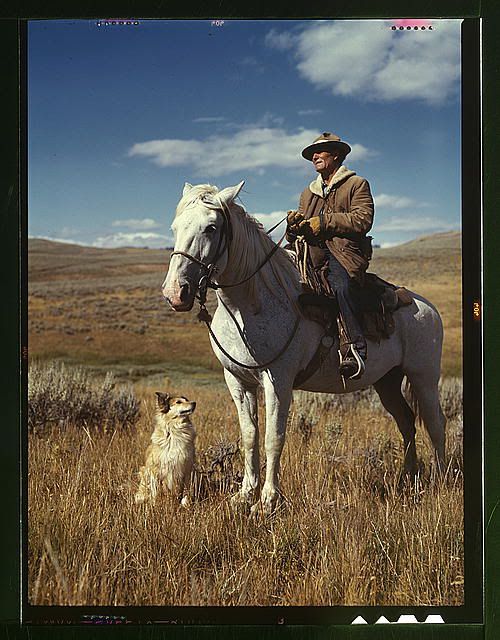
In a troubling time following the Great Depression, when many of the major countries of the world are fighting in World War II, a photograph such as this might, at first glance, appear to be peaceful and worry-free. But, is this sheep herder's life truly any more relaxing than the lives of those experiencing the war firsthand? This photograph, among a large group of others, was taken to simply depict the way of life in various regions of the United States during the war. But behind this most basic of goals, the photographer is making an argument about the sheep herder's way of life, and, as an extension, our preconceived notions of the typical American Old West cowboy. Through this picture, the photographer wants the audience to experience, first hand, the arduous struggles of the sheep herding culture made all the more difficult by the unnerving lack of any human contact. The major elements of the photograph are aligned in such a way that the nature of the relationships between these elements can be clearly seen. These elements are contrasted against the background in order to draw the attention of the audience and bring into question the major differences between the background and foreground. Furthermore, through methods of strategically framing the photograph, the background is given a role that rivals the importance of the elements in the foreground.

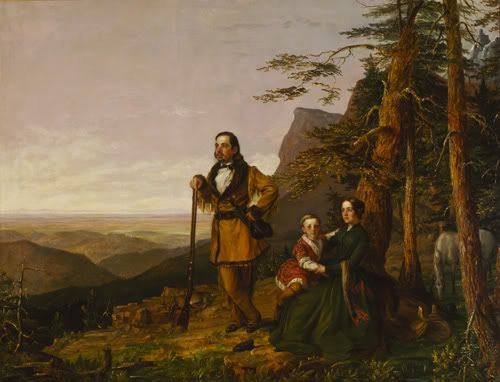
In the primary photograph, both the shepherd and his horse are facing the left edge of the picture. This is similar to nearly every picture I found depicting the idea of Manifest Destiny in which people are shown either traveling or looking to the left. These leftward vectors of attention are used because, to an audience viewing a picture, left is easily associated with a westward direction. Because the primary photograph was taken in 1942, the photographer, Russel Lee, most likely wasn't trying to make the audience think of Manifest Destiny itself so much as the time period and the traditional sense of the "American Old West." In this sense, the photographer is using logos to present the shepherd as a sort of classical representation of the stereotypical tough, gun-slinging cowboy who has experienced all sorts of rough adventures out in the "Wild West."

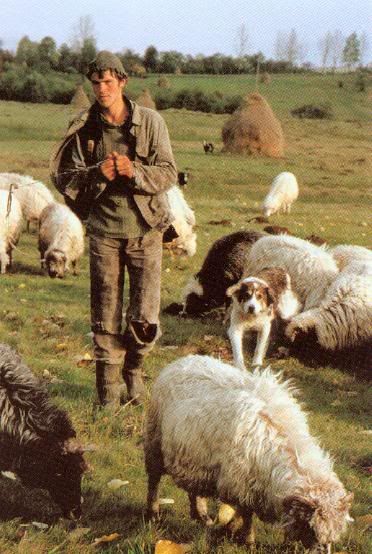
An overwhelming number of sheep herders originated from regions in Spain and France that make up the Basque Country. Many Basques immigrated to America in order to start making a living. In most cases, Basque people planned on moving back to their homeland to start their own business once they had made enough money farming or herding in America. Most Basque immigrants chose sheep herding as a profession because a history of farming and hard work had prepared them for such a business. The shepherd's way of life turned out to be a bit tougher than initial speculations, though. While most shepherds stood strong through rough times, many changed professions after a few years primarily because of the overwhelming sense of complete social isolation. The sheep's constant demand of the shepherd's supervision played a major role in this, too. (Laughlin)

This complete social isolation is a major focus of the primary photograph, presented by the choice of background. The background displayed in the primary photograph is only a small portion of a large area known as Gravelly Range in Madison County, Montana, where ranching is a major business activity. The picture to the left, however, shows another view of Gravelly Range. Clearly, this depiction of the extensive mountain range differs greatly from the primary photograph. For one, the number of elements is far greater than the background of the primary photograph. In this photograph, rocks are scattered in the grass, trees are spread throughout the rolling hills, snowy mountains tower high above the trees, and numerous clouds cover the sky. The background of the primary photograph contains only grass-covered hills and a blue sky with some clouds in the distance. The simplicity of the background does more than help to direct the attention of the audience towards the shepherd, horse, and dog; it emphasizes the lonely life of solitude that attacks the sheep herder from every angle. Additionally, the scale of the clouds is used in a way that makes the hills seem to stretch into infinite distances, overpowering the shepherd with a vast, uninhabited land from which there is no escape.

Most people would expect a photograph of a sheep herder to include at least a portion of the sheep herder's flock. However, in the primary photograph's situation, adding sheep to the picture would display additional relationships, which would do all but support the photographer's argument. Including multiple relationships within the photograph wouldn't necessarily mean that the shepherd has a strong companionship with every single sheep, but it would take the focus of the audience away from the empty background, losing the emphasis on the solitary conditions of the sheep herding way of life. Clearly, the photographer frames his picture in a way that highlights the solitude experienced by shepherds and, furthermore, cowboys in general.

The shepherd isn't completely alone, however; he always has his trusty horse and loyal dog. The dog, in specific, is aligned with the shepherd in such a way that the audience easily notices the relationship between the two of them. The dog's vector of attention is directed straight up to the shepherd, and his posture suggests that he is ready to jump at any command given by his master. Here, the herding dog is used as a symbol of companionship and loyalty, creating the perfect image of "man's best friend." To many sheep herders, this is exactly the relationship that should exist between shepherd and herding dog. One present day shepherd describes this relationship as "a partnership in which both the shepherd and the dog work together out of mutual trust and respect" (Nickelsberg 5). The close relationship between the herding dog and the shepherd display the strongest form of companionship experienced by the shepherd, which makes the relationship all the more noticeable to the audience. However, this is clearly a non-human relationship; thus, despite the strong companionship, the shepherd remains disconnected from society.

Clearly, both the emptiness of the background and the shepherd's companionship with the dog are extremely important aspects of the photograph. In a sense, the background and foreground both contrast and compliment one another. The contrasting concepts of companionship and solitude clash, just as they stand out in the photograph. While the sole relationship between the shepherd and his dog are made even more noticeable because of the background's pathos of solitude and emptiness, the background, in turn, is made more noticeable because of the few elements in the foreground. In other words, the shepherd's companionship with the dog emphasizes the background and its tendency to create feelings of loneliness. The photographer highlights the overlooked aspects of the typical image of the American Old West cowboy, turning the once thought of American dream into somewhat of a nightmare.

So what do the difficult lives of sheep herders in 1942 have anything to do with our lives today? Most of us here probably don't spend our time in the mountains herding sheep all day; however, many professions today can be viewed in a similar manner. Some sheep herders and cowboys may have viewed solitude as a chance to escape the troubles of World War II, but I'm sure many of them weren't so optimistic after experiencing it first-hand for several consecutive days. The individual's that stuck with it, though, are the one's that contributed to the magnificent symbol that many of us imagine when talking about cowboys.


Works Cited

Laughlin, Mike. "Basque Ranching Culture." 2009. Lee Raine. 18 Sept. 2009 <http://www.cowboyshowcase.com/basque.htm>.

Nickelsberg, Ellen. "Large Flock Sheep Herding: The Working Relationship." 2009. Ranch Dog Trainer <http://www.german-shepherdherding.com/sheepherding.htm>.